


A shopper lands on your product page, scrolls, clicks through the images, maybe even opens the shipping tab, and then leaves. Another adds to cart, starts checkout, sees the final total, and disappears. A trial user signs up, pokes around for a few minutes, and never comes back. In each case, your analytics can tell you what happened, but not why. That is where customer feedback surveys earn their keep.
They reveal the questions, doubts, and friction points that stop people from moving forward. In this guide, you will find ready-to-use survey templates and questions designed to help you improve conversions at the moments that matter most.
5 customer feedback survey types that actually improve conversions
Most customer surveys fail because they ask broad questions at the wrong time. The survey types below are designed to help you answer very specific questions, like why shoppers are not adding to cart, why buyers abandon checkout, what persuaded someone to purchase, why trial users sign up but never activate, or why customers return, cancel, or do not come back.
That’s what makes them useful for conversion optimization: they help you diagnose a specific problem instead of collecting vague feedback.
Here are five customer feedback survey types that actually improve conversions:
- On-page surveys for non-converters: high-intent pages like product, pricing, cart, and checkout pages to catch hesitation or confusion, stopping your audience from converting. For example, if visitors keep asking “What questions do you still have before buying?” about shipping time, sizing, or refunds, that is your cue to tighten the page. This works especially well with a conversion optimization tool like FigPii, which lets you run on-site polls and compare survey answers with session recordings and heatmaps to see where people pause, stop scrolling, rage-click, or drop off.
- Exit-intent surveys: Use these when someone is about to leave to find out what stopped them before they disappear. For example, asking “What’s stopping you from completing your purchase?” on cart or checkout pages can show whether the issue is extra costs, low trust, unclear returns, or just confusion.
- Post-purchase surveys: Use these right after someone makes a purchase to understand what convinced them, which channels influenced them, and what nearly stopped them. For example, questions like “How did you first hear about us?” and “What almost stopped you from buying?” can show whether buyers came through word of mouth, an ad, or a review, and which objections almost lost the sale.
- Post-signup or trial surveys: Use these after someone signs up, books a demo, or starts a trial to understand what they want to achieve and what might block activation. For example, asking “What are you hoping to accomplish first?” or “What feels unclear so far?” can reveal whether onboarding is confusing, setup feels too heavy, or the product is not matching expectations.
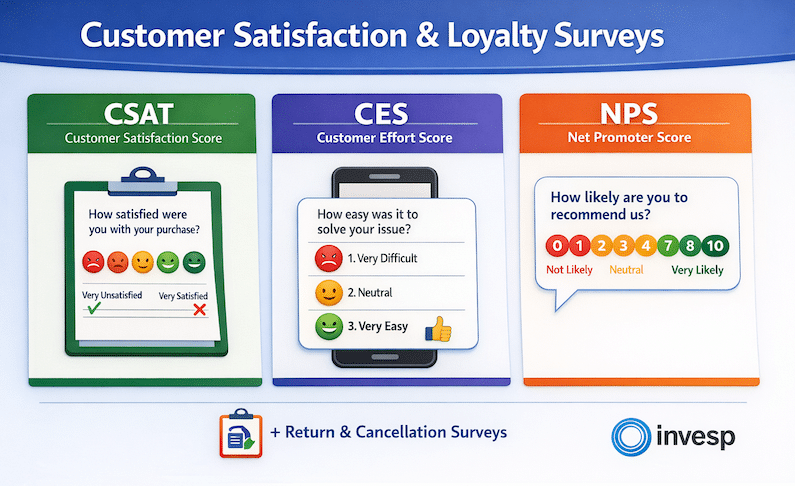
- Customer satisfaction or loyalty surveys: Use CSAT to measure customer satisfaction, CES to gauge how easy or difficult the experience was, and NPS to gauge how likely customers are to recommend you, along with return or cancellation surveys, to identify problems that hurt repeat purchases and retention.
Customer feedback survey templates and questions
The best customer feedback surveys do not ask for feedback just to collect it. They help you uncover a specific point of friction, hesitation, or motivation at the exact stage where it affects conversion. The templates and questions below will help you do exactly that.
1. When shoppers are not adding to the cart
If shoppers are reaching your product page but not adding the item to cart, do not assume the problem is traffic quality. More often, the page leaves one or two important buying questions unanswered.
In fact, product pages are still a weak spot for many ecommerce brands: Baymard’s latest benchmark found that 52% of desktop sites and 62% of mobile sites have “mediocre” or worse product page UX.
Shoppers usually hold back for one of five reasons:
- They need more product information
- They are not sure the product is right for them
- They have questions about shipping or returns
- The price feels too high
- They want to compare other options first
Brands like TUSHY address this by answering practical pre-purchase questions right on the product page, including installation, compatibility, and product features, instead of forcing shoppers to go hunting for reassurance.
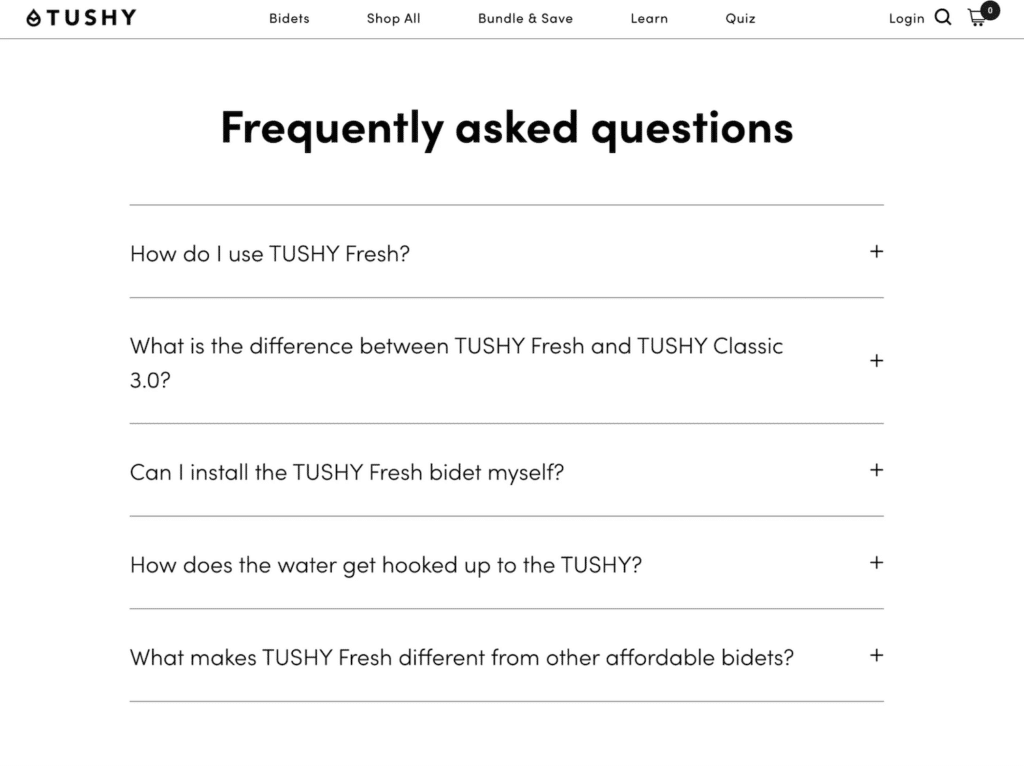
TUSHY answers common pre-purchase questions right on the product page (Source)
Best question to ask first:
For most brands, the best starting question is “What’s stopping you from adding this to your cart today?“
This works better than a broad open-ended question because it is specific, easy to answer, and directly tied to the conversion step you are trying to improve.
Ready-to-use survey template:
Heading: Quick question before you go
Question: What’s stopping you from adding this to your cart today?
Answer options:
- I need more product information
- I’m not sure this product is right for me
- I have questions about shipping or returns
- The price feels too high
- I want to compare other options first
- I’m just browsing
- Other
Optional follow-up: Tell us more
CTA: Submit feedback
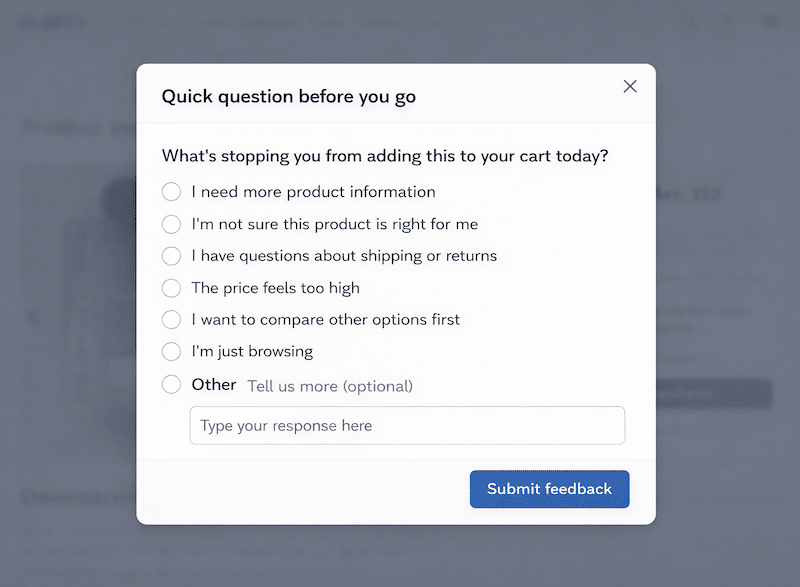
This format is stronger than a blank text box because it lowers effort for the shopper and gives you cleaner patterns to analyze. You still get nuance from the optional text field, but you are not forcing every visitor to write a full answer.
What each answer usually tells:
- I need more product information: your product page is missing practical buying details such as dimensions, ingredients, materials, compatibility, or use-case clarity.
- I’m not sure this product is right for me: shoppers need stronger fit guidance, comparison help, or proof that the product suits their situation.
- I have questions about shipping or returns: the reassurance is too weak; the page does not reduce purchase risk enough.
- The price feels too high: the value is not landing, and shoppers do not yet see why the product is worth the price.
- I want to compare other options first: differentiation is weak, and the product page isn’t helping shoppers understand why this option stands out.
- I’m just browsing: not every non-converter is a page problem, and some visitors simply are not ready yet.
2. When shoppers abandon checkout
If shoppers have already added something to their cart and started checkout, you are no longer dealing with low intent. At that point, they are close to buying. So when they leave, the problem is usually friction, surprise, or anxiety, not a weak product page.
Baymard’s latest benchmark puts average cart abandonment at 70.19%, indicating that checkout remains where a large share of revenue disappears.
What usually causes that drop-off? Baymard’s checkout-abandonment research points to a familiar set of problems:
- Extra costs that appear too late
- Forced account creation
- Slow delivery
- Lack of trust in the site with card information
- Long or complicated checkout
- Not seeing the total cost upfront
- Unsatisfactory return policies
- Website errors
- Limited payment methods.
Shopify’s checkout guidance reinforces the same pattern: shoppers leave when checkout feels longer, more restrictive, or less convenient than expected.
That is why checkout surveys need to be tighter than product-page surveys. Do not ask broad questions like “Do you have any feedback?” or “Why didn’t you buy?” Those are too vague. At checkout, you want to quickly identify the exact barrier standing between intent and purchase.
Best question to ask first:
For most brands, the best starting question is: What’s stopping you from completing your purchase today?
This works because it is clear, direct, and tied to the moment. It also makes it easier to separate real checkout friction from lower-intent browsing.
Ready-to-use survey template:
Heading: Before you go
Question: What’s stopping you from completing your purchase today?
Answer options:
- Shipping costs are too high
- I still have questions about delivery or returns
- I don’t trust entering my payment details
- Checkout feels too long or complicated
- I want to compare options first
- I ran into a technical problem
- Other
Optional follow-up: Tell us more
CTA: Submit feedback
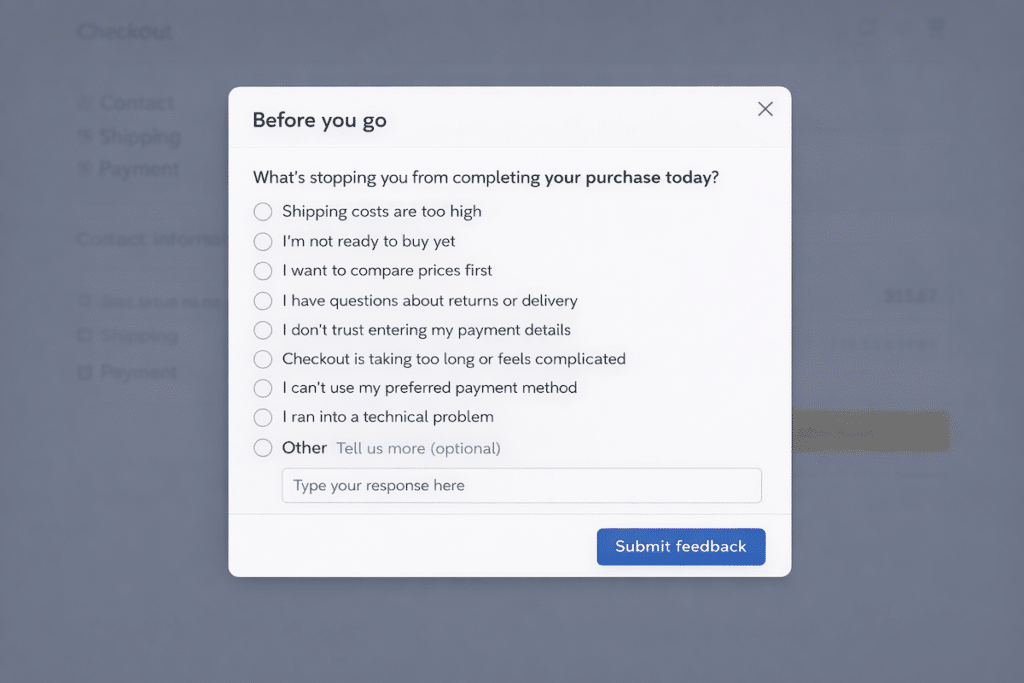
What each answer usually tells:
- Shipping costs are too high: The cost feels like a late surprise, or your pricing and shipping policy are not framed well enough before checkout.
- I want to compare prices first: Value is not landing clearly enough, or competitors are still in the consideration set.
- I have questions about returns or delivery: Reassurance is too weak at the point where risk feels highest.
- I don’t trust entering my payment details: Your checkout may lack credibility cues, recognizable payment methods, or overall trust.
- Checkout is taking too long or feels complicated: Too many steps, too many fields, or too much friction.
- I can’t use my preferred payment method: You may be losing buyers simply because checkout is too rigid.
- I ran into a technical problem: Bugs, slow pages, coupon issues, or mobile usability problems may be breaking the flow.
3. When you want to know what drove the purchase
Once someone has bought, you have a short window where their motivation is still fresh. That makes post-purchase surveys one of the best ways to learn what actually convinced them to buy, which channel influenced them first, and what nearly lost the sale.
You are trying to answer questions like:
- What first put us on their radar?
- What made them choose us over another brand?
- What almost stopped them from buying?
- Which message, offer, or proof point actually mattered?
A good real-world example is Weezie. By using a post-purchase attribution survey, the brand found that about 35% of its business came from word of mouth, which helped validate where demand was coming from and gave the team a clearer basis for budget decisions.
Best question to ask first:
For most brands, the best starting question is: How did you first hear about us (HDYHAU)?
This works because it’s simple, easy to answer, and gives you a signal you can actually use. It is especially useful for channels that are often undercounted or muddied in analytics, such as word of mouth, podcasts, creators, organic social, and offline mentions.
Ready-to-use survey template:
Heading: Thanks for your order
Question: How did you first hear about us?
Answer options:
- TikTok
- Google search
- YouTube
- Friend or family
- Podcast
- Newsletter or email
- Creator or influencer
- Online article or press
- I do not remember
- Other
Optional follow-up: What made you decide to buy today?
CTA: Submit feedback
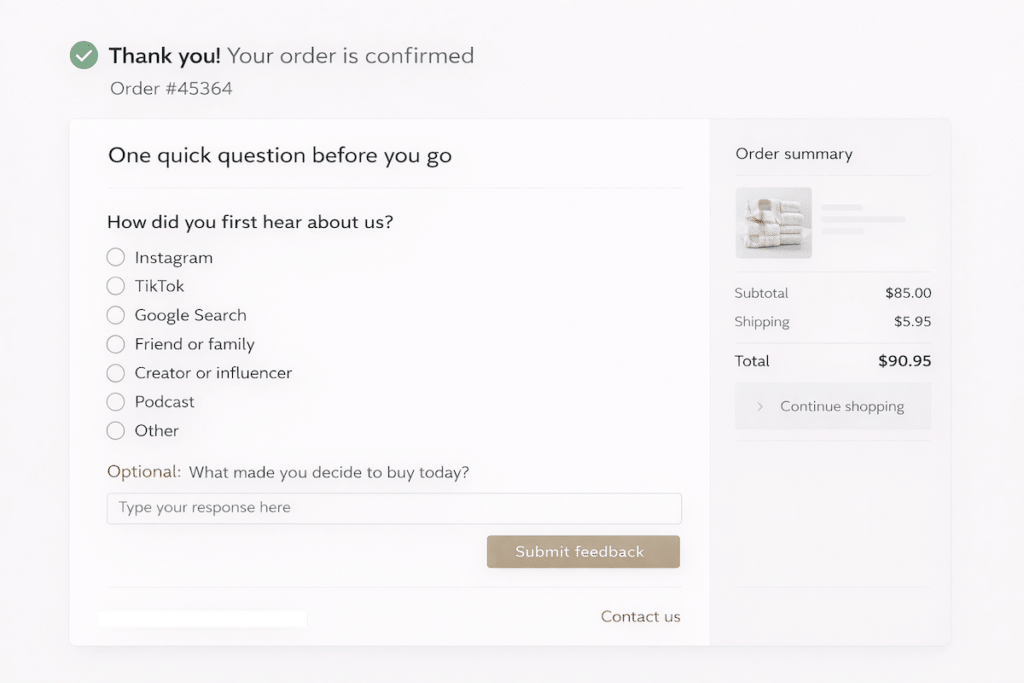
What each answer usually tells you:
- Instagram / TikTok / YouTube: your brand is being discovered through content, not just intent-driven search.
- Google search: the customer likely had an existing demand and sought a solution.
- Friend or family: Word of mouth may be doing more work than your dashboards show.
- Podcast/creator/influencer: top-of-funnel awareness is being shaped by trusted voices.
- Newsletter or email: owned channels helped convert the demand you had already built.
- I do not remember: the journey was probably multi-touch, which is common for considered purchases.
4. When trial users sign up but do not activate
If trial users sign up but do not activate, they are getting in but not getting the value. Usually, they do not know what to do first, the setup feels too time-consuming, or the product does not show its usefulness quickly enough.
This is not a small or unusual issue. Amplitude’s product benchmark report found that by day 14, the median product has only about 2% of new users still active. Even top-performing products are only at about 9%. That tells you how easy it is for new users to drop off if they do not find value fast.
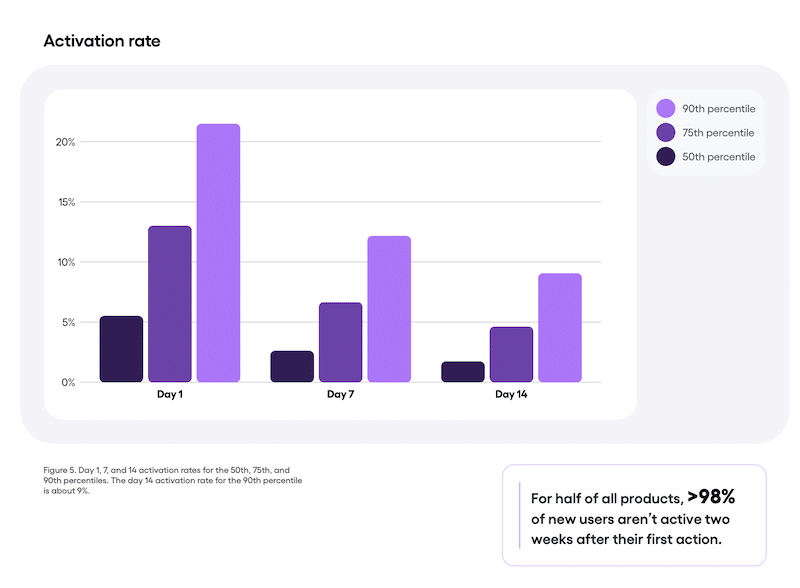
Bar chart showing product activation rates on day 1, day 7, and day 14 across the 50th, 75th, and 90th percentiles, with much lower activity by day 14 (Source)
Best question to ask first:
For most SaaS products, the best starting question is: What’s stopping you from getting started today?
This works because it is simple, specific, and close to the moment of friction. It helps you identify whether the problem is confusion, setup effort, uncertainty, or lack of perceived value.
Ready-to-use survey template:
Heading: One quick question
Question: What’s stopping you from getting started today?
Answer options:
- I’m not sure what to do first
- The setup feels too time-consuming
- I’m not sure this product is right for my needs
- I don’t see the value yet
- I need help from my team before continuing
- I’m just exploring for now
- I ran into a technical issue
- Other
Optional follow-up: Tell us more
CTA: Submit feedback
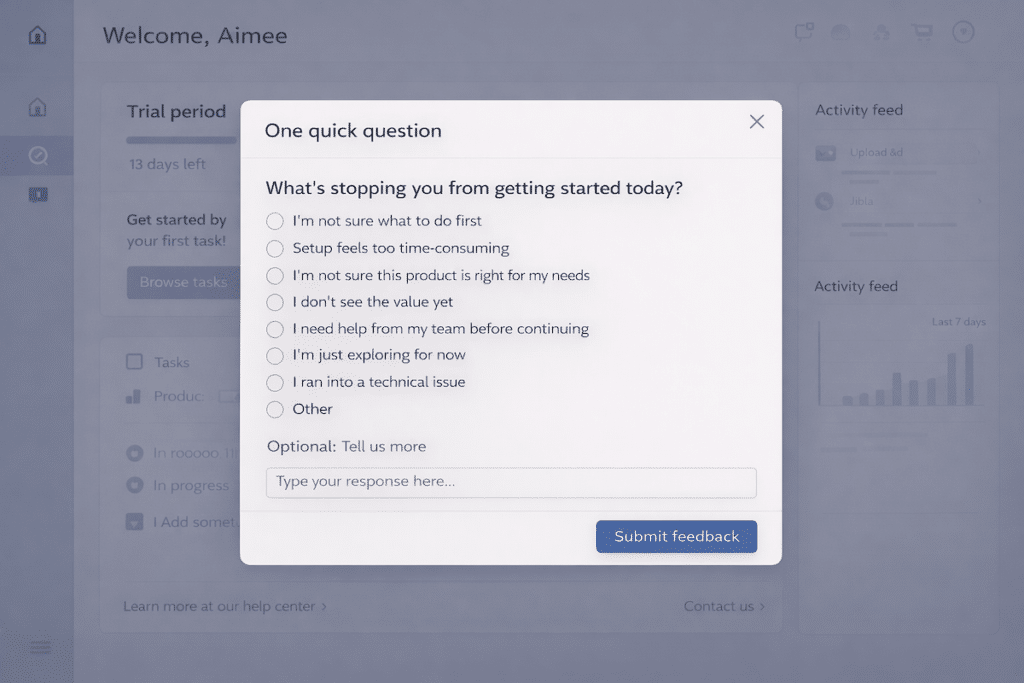
What each answer usually tells you:
- I’m not sure what to do first: Your onboarding isn’t giving users a clear first-success path.
- Setup feels too time-consuming: Time-to-value is too long, or you are asking for too much too soon.
- I’m not sure this product is right for my needs: The product, onboarding, or messaging isn’t connecting the tool to the user’s actual job-to-be-done.
- I don’t see the value yet: The product is not getting users to a meaningful outcome fast enough.
- I need help from my team before continuing → activation may depend on collaboration, approval, or data the user does not have yet.
- I’m just exploring for now: Not every inactive trial user is lost, some are still in evaluation mode.
- I ran into a technical issue: Bugs, integrations, login issues, or setup failures may be blocking progress.
If you want a more specific signal, use one of these instead when you already know what you are trying to diagnose:
- To uncover onboarding confusion: What feels unclear so far?
- To uncover value gaps: What were you hoping to accomplish first?
- To uncover setup friction: What is making it hard to get started?
- To uncover expectation mismatch: What were you expecting to be easier or faster?
5. When customers return, cancel, or do not come back
If a customer has already bought from you and then returns the item, cancels the subscription, or never comes back, the problem is no longer just about conversion. It is an expectation mismatch. Something in the product, offer, delivery, fit, onboarding, or ongoing value did not match what the customer expected.
That matters because returns are expensive and retention is where much of the profit is made. NRF said retailers expected 16.9% of annual sales to be returned in 2024, and 19.3% of online sales to be returned in 2025. Bain’s loyalty research also argues that small improvements in retention can have an outsized impact on profits over time.
In plain terms, customers usually return, cancel, or disappear for one of six reasons:
- The product did not match expectations
- Fit, setup, or usability was worse than expected
- The value no longer feels worth the price
- Delivery, support, or service created friction
- They did not need the product as much as they thought
- A competitor or alternative solved the problem better
You can see this pattern in returns research, too. PowerReviews found that poor fit was the most common reason shoppers gave for returns in its retail survey, while other returns research points to unmet expectations, damaged items, and incorrect fit as recurring drivers of post-purchase dissatisfaction.
That is why this survey should be short and to the point. Do not ask broad questions like “How was your experience?” or “Any feedback?” when someone is already on the way out. You want one question that quickly helps you identify the main reason, plus an optional field for context.
Best question to ask first:
For most brands, the best starting question is: What is the main reason for your return, cancellation, or decision not to buy from us again?
This works because it is direct, easy to answer, and flexible enough to work for ecommerce returns, subscription cancellations, and post-purchase churn.
Ready-to-use survey template:
Heading: One quick question before you go
Question: What is the main reason for your return, cancellation, or decision not to buy from us again?
Answer options:
- The product did not meet my expectations
- It was too expensive for the value
- It was not the right fit for my needs
- I had issues with shipping, delivery, or timing
- I had a poor support or service experience
- I found a better alternative
- I ran into a technical or quality issue
- Other
Optional follow-up: Tell us more
CTA: Submit feedback
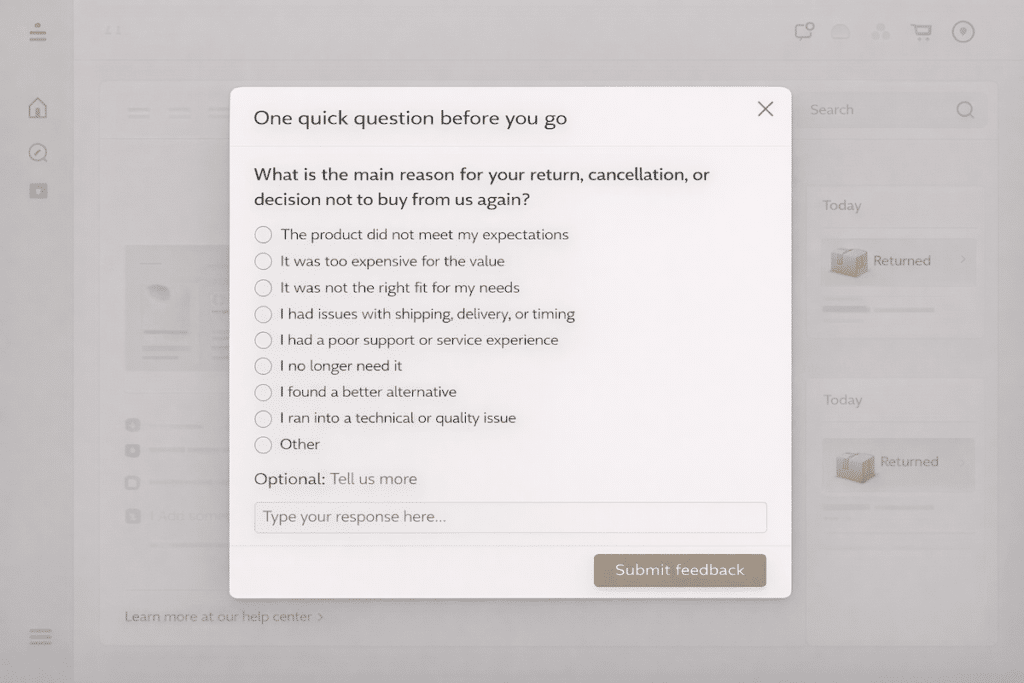
What each answer usually tells you:
- The product did not meet my expectations: Your messaging, product page, demo, or sales promise likely overreached.
- It was too expensive for the value: The product may be fine, but the value is not landing strongly enough after purchase.
- It was not the right fit for my needs: Shoppers or users needed better fit guidance, clearer use cases, or more honest qualification upfront.
- I had issues with shipping, delivery, or timing: Operational friction is hurting retention, not just satisfaction.
- I had a poor support or service experience: The problem may be solvable, but the relationship took a hit.
- I found a better alternative: Your differentiation weakened after the first purchase.
- I ran into a technical or quality issue: Product reliability, defects, bugs, or setup friction are likely doing the damage.
How to write customer feedback survey questions that get useful answers
A customer feedback survey is only as useful as the questions you ask. If your question is too broad, too vague, or too hard to answer quickly, you will get weak data back. The goal is to make it easy for someone to tell you exactly what blocked them, helped them, or convinced them.
- Be specific about the moment: Ask questions that are tied to a real moment in the journey. “What do you think of our website?” is too broad. “What’s stopping you from adding this to your cart today?” is much better because it focuses on one decision point.
- Don’t lead the customer: Avoid wording that pushes people toward the answer you want. If you ask, “Was shipping too expensive?” you may get answers about shipping even when that was not the real issue. Instead, ask something like “What’s stopping you from completing your purchase today?” to allow the customer to tell you what actually happened.
- Use the customer’s language: Write the question the way a real customer would describe the problem, not the way your team talks about it internally. For example, instead of “Did our pricing and value proposition feel clear?” ask “Did the price feel worth it?” and instead of “What onboarding friction did you face?” ask “What made it hard to get started?”
- Make the question easy to answer: If a question takes too much effort, most people will skip it or give you a lazy answer. Instead of forcing open text with “Why didn’t you buy?”, use “What’s stopping you from buying today?” with options like I need more information, The price feels too high, or I have shipping questions.
- Ask close to the experience: The longer you wait, the fuzzier the answer gets. Ask “What’s stopping you from adding this to your cart today?” on the product page, “What’s stopping you from completing your purchase today?” at checkout, and “How did you first hear about us?” right after purchase.