


Let’s start with some customer loyalty stats
- 65% of business comes from existing customers
- Repeat customers spend 33% more.
- The cost of acquiring new customers is five times higher than that of retaining old ones.
It’s a great thing to have your customers come back for more.
Unfortunately, gaining their loyalty isn’t easy.
Nowadays, choices are overflowing, and customers are getting pickier. 77% of brands could disappear, and customers wouldn’t bat an eyelash. One-third of millennials won’t hesitate to drop a brand like a hot potato if it doesn’t meet their expectations.
To gain customer loyalty, you need to connect with them emotionally. You have to transform the “brand-customer” relationship from transactional to emotional.
How do you ask?
Well, in this article, I will cover how to get your audience emotionally attached.
Let’s dive in.
Decision-making and the power of emotions
We have all been led to believe that our decisions are rational. Everything we decide is based on the pros and cons. Even early economists formulated their theories based on such assumptions.
That’s how it should be in a perfect economic world. But we don’t live in an ideal world.
Often our emotions override our logic and reasoning. And it has to do with our brain. Thanks to thousands of years of evolution, our brain now has three parts: 1.) Reptilian brain. 2.) Limbic brain. 3.) Neocortex.
The reptilian brain is responsible for survival reflexes.
The limbic brain oversees our emotional responses.
The neocortex is the latest development. It controls all logical reasoning.
From an evolutionary standpoint, the limbic brain is more mature than the neocortex. As a result, when these two conflict, the limbic brain gains the upper hand.
Why do you think people smoke even after knowing how dangerous it is for health?
Even when we purchase, the same thing happens. We make buying decisions based on our emotions. And our attachment to any particular product or brand is also emotional.
Therefore, your marketing messages should take into account users’ emotional makeup.
There are many ways to identify the emotional driving factors of the audience. However, I would like to discuss a specific marketing tool, the Limbic model.
Limbic Model
What sets the Limbic model apart from the rest is its direct address of human motives and emotions. The limbic model reveals the different emotional systems in customers’ heads, how those systems interact, and how they shape behavior.
We have three broad emotional systems inside our heads. One of these three dominates the other two. However, dormant ones also shape an individual’s personality and preferences.
- The Balance: The balance system is responsible for our tendency to conform and to seek security. Simply put, a person with an overpowering balance system tends to avoid risk and is less likely to challenge the status quo.
- The Dominance: If you consider the balance system as “defensive,” then the Dominance system is “assertive.” Power, status, pride, and competitiveness —individuals with a proponent dominance system love to exert their will and win all the time.
- The Stimulant: The stimulant system is all about adventure and novelty seeking. People with this system might have a keen interest in learning and applying new things. Some common behaviors associated with stimulant systems include curiosity, knowledge-seeking, and creativity.
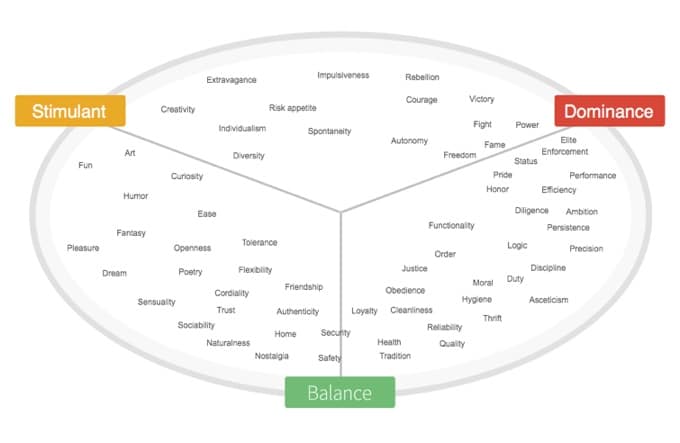
Now, though we are all dominated by one system, the other two do leave a mark to a varying degree. For example, two individuals with the Dominance system might have different personalities. One of them might prefer status and ambition, thanks to the influence of the Stimulant system. While the other might value qualities like justice and loyalty if the Balance system has a significant effect.
By taking into account the interactions between emotional systems on personality, scientists came up with seven Limbic types:
- Hedonists: Curious, loves novelty, fun, creative, impulsive, extroverted.
- Adventurer: Rebellious, thrill-seeker, self-reliant, risk-taker.
- Performer: Loves challenges, go-getter, focuses on success, ambitious, assertive.
- Disciplined: Logical, disciplined, dutiful, prefers clear structure.
- Traditionalist: Sticks to tradition, protective, has a strong sense of justice, frugal, loyal.
- Harmonizer: Authentic, family/community-oriented, caring, craves a sense of security, conformist.
- Open-minded: Openness to new ideas and experience, sensual, flexible, dreamer, tolerant, has a sense of humor.
Understanding your customers’ limbic type helps to design marketing experiences according to their emotional profiles.
How to connectwith users by appealing to their emotions
But why do only a small number of companies inspire such loyalty while others can’t?
Because humans don’t get attached to an entity; instead, we get attached to personality. Whenever we describe a person, right after their visual description, we talk about their personality.
Branding experts behind successful brands understand this. Thus, they offer a brand experience that feels as if the brand itself has a distinct “personality.” And when a brand hints at a brand personality, customers feel a connection.
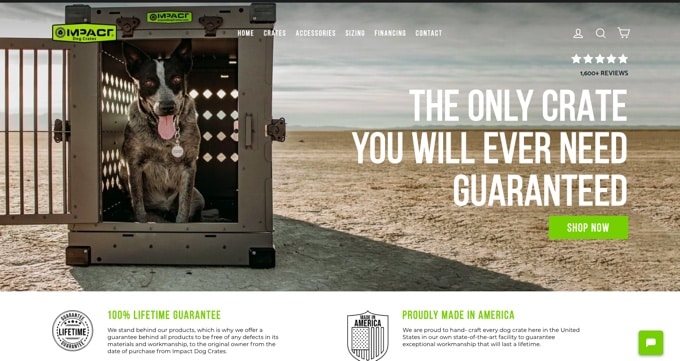
Take, for example, Impact Dog Crate. They are not the biggest brand, but they are not some faceless organization either. They are passionate about dogs and American culture. Their blog and video library are full of useful content. They offer unique benefits to veterans and support charitable events. Their website copy and design reflect their values.
When it comes to building connections, they would be ahead of their competition.
In the following sections, we will discuss how you can connect with your audience and join the ranks of a few brands that are doing it right.
2.1 Emotional Design
According to researchers, a strong first impression boosts the overall impact of the product.
And when it comes to making your viewers say, “wow! That’s cool,” the visual appeal is unmatched. It even beats usability. Test after test proves that people assume attractive products function better. And after repeated purchases, they even backward-rationalize that they like those products. In other words, the right design can contribute to customer loyalty.
Now, what impresses an individual depends on their emotional profile. Something impressive to a hedonist might not be appealing to a traditionalist.
That’s why you want to choose an emotional design that considers your audience’s preferences.
The term “Emotional design” is self-explanatory. These are the design patterns engineered to evoke certain emotions. You start with a message in your mind and, through design, evoke emotions like joy and excitement to amplify that message.
According to Don Norman, any successful emotional design hooks the viewer in three different levels:
- The Visceral level- This is the first impression based on the look and feel. Designs that engage the viewer’s limbic system have a positive impact.
- The Behavioral level: Once viewers form a first impression, their logical brain kicks in. The logical brain analyzes both the usability and ease of navigation. On this level, a great design triggers specific desirable user behavior.
- The Reflective level- This level is a conscious one. Based on their impression of the first two levels, viewers choose their actions logically.
To hook your users in all three levels, your design should check off these three boxes:
1. Color
Colors are crucial in design because they evoke emotions. Brighter colors stimulate our emotional centers inside our heads, which leads to an evaluative reaction- either we like it, or we don’t. And this evaluative reaction leads to prompt actions, such as impulsive buying.
Cooler colors, on the other hand, help reduce arousal and encourage relaxation. Cool colors also shorten our perception of time. That’s why checkout feels shorter when cooler, softer colors are used in design elements.
While designing, keep in mind that the emotional association of color could vary, depending on hue and tint. For example, Crimson, a variant of red, is often linked to aggression, power, and blood. Pink, another shade of red, stands for romance and kindness.
Here is an example of a smart color choice. The whole design is based on fresh colored design elements with ample white space in between.
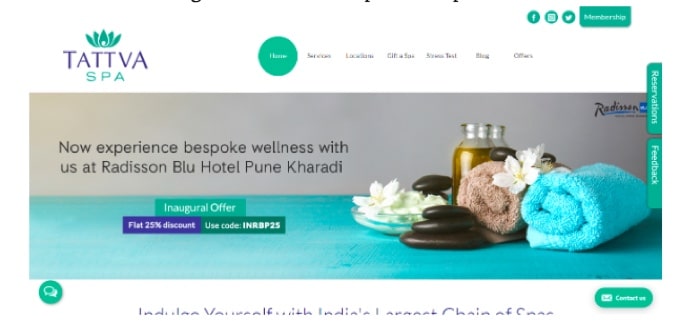
The first impression of this design is calm, cool, and relaxing. Chances are good that viewers would spend more on this site and request appointments. Here is another example.
Soft Surroundings is a women’s clothing brand with a mission of celebrating femininity. As they put it on their website, “Soft Surroundings gives women a way to take a moment in their busy lives and be good to themselves.”
Their website design fits well with the brand image and radiates a soft, relaxed, and feminine vibe.
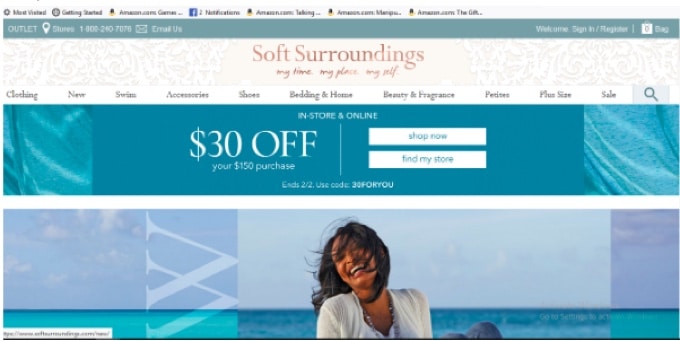
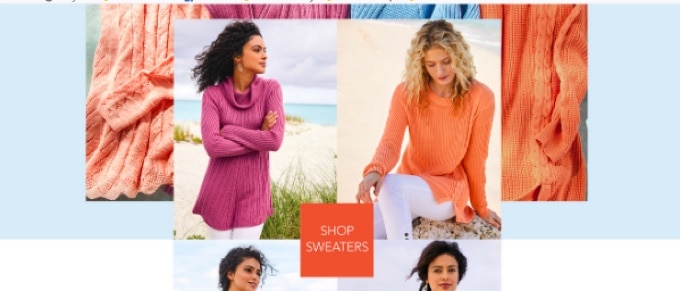
Header, images, banner — Pastel colors like salmon, light purple, and cream are everywhere in this design. Pastel colors are associated with femininity and have a soothing effect. Therefore, designers used those colors to create a design that feels warm and relaxing.
Also, there is plenty of blank space (which reduces visual clutter), and it is light aquamarine instead of white. Aquamarine has a relaxing effect on our psyche. So, such a colored blank space further enhances the rejuvenating feel.
2. Images and visuals
Images are not just for looking pretty. The impact of an image on design is indeed profound. However, I won’t go into that in depth because you can find many great articles online.
Instead, let’s talk about how images help you to use two powerful tools straight from a psychology book:
1.) Priming
2.) Emotional contagion.
1. Priming
Priming is the act of introducing a stimulus that gives cues to the existence of another stimulus and influences human behavior. For example, if you hear the word “ride,” you would immediately think of words like bike or car. In the case of emotional design, images allow you to use priming. The right image could prompt behaviors such as spending more time on the website or clicking the sign-up button.
Sometimes this connection between stimulus and action could be very obvious. For better understanding, take another look at the example above. That image of a flower, oil, and smooth black stone makes you think about a relaxing spa environment. That image serves as the first stimulus that primes your thoughts about spa sessions.
However, in some cases, things are not that straightforward. You might need to use images to evoke a feeling rather than trigger mental images. Let me show you an example:

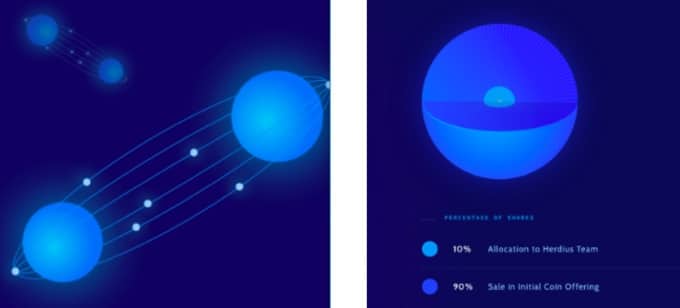
Now here is a word of caution. Priming is very powerful, but use it responsibly. Otherwise, you would run into the issue of negative priming where the stimulus triggers a behavior that defeats your purpose.
And keep in mind that there is always a chance of gradual decline in the degree of triggered response. You don’t check your Facebook notification every time your phone beeps, do you? Someone new to social media would be far more excited.
Long story short, priming isn’t magic, but that doesn’t mean you shouldn’t grab what it has to offer.
2. Emotional Contagion
Emotional contagion is the phenomenon of having one’s emotions transferred to another. Ever wondered why positive and happy people are a blast to hang with? Because of emotional contagion, their positivity is siphoned off to others.
With the right images, it’s possible to evoke virtually any emotion and subtly spread it among viewers. According to research, people experience emotional contagion when watching advertisements. When test subjects are shown ads featuring happy faces, they feel delighted too. This phenomenon doesn’t hold only for positive emotions.
Interestingly, another study found emotional contagion doesn’t always need to be directly related to the product. You can use an unrelated image, and viewers can still anchor their feelings to it. For example, if viewers feel excited after spotting a picture of their favorite celebrity, that same emotion carries over to the product associated with that image.
Another example of indirect emotional contagion is the usage of food images on restaurant websites.
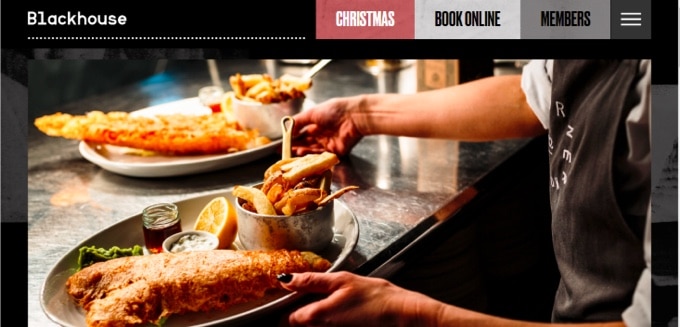
These images play on viewers’ craving for food and indirectly plant the idea in their heads that a specific restaurant equals yummy food.
3. Reduce cognitive load
Users hate having to pay extra attention to find basic information. Instead, they prefer to move on to the next website or business.
In his book “Don’t Make Me Think,” Steve Krug wrote:
As a rule, people don’t like to puzzle over how to do things. The fact that people who built the site didn’t care enough to make things obvious– and easy–can erode our confidence in the site and its publishers.
According to psychologists, a high cognitive load is a reason behind such behavior.
Cognitive load is a fancy term for the amount of brainpower required to complete a task. Driving, strolling in the park, listening to a song —every activity puts some cognitive load on our memory. It goes wrong only when that load crosses a certain threshold. Researchers found high cognitive load disrupts performance in tasks requiring at least some degree of attention.
If your design, no matter how pretty it is, makes viewers work hard, you are drifting away from the goal —the emotional connection.
So stick to an intuitive and straightforward design. An intuitive design leads to higher user satisfaction. And user satisfaction is positively related to brand loyalty.
Any intuitive design stands on two principles: 1. Simplicity 2. Familiarity.
1. Simplicity
Our working memory holds 7, plus or minus 2, pieces of new information at any given time for 20 sec. Anything more than that, and our memory has to stretch itself.
Keeping this limitation in mind, you want to limit the information that must be processed, both in quantity and complexity. There are a few ways to do it. You can break down any task into multiple steps, remove visual clutter, add a clear CTA for each task, and so on.
2. Familiarity
It’s tempting to be different and cool. However, being creative doesn’t always mean better. When Bucknell University tried a better-looking design in 2014, it performed worse.
Our brain learns new things by processing data in real time. However, after enough repetition, you no longer have to think about it. Our working memory refers to the process of our long-term memory being used and completed. In other words, familiar things are less cognitively taxing.
The same goes for your design. So at least stick to fundamental conventions. Don’t put your menu on the right side instead of the top. Or use unfamiliar icons. Or use poetic lines or metaphors which are hard to relate.
3. Using the right words in copy
Many marketers make a fundamental mistake. They feel the only way to make sales is to convince users that their product is the best, even when identical products are available.
It doesn’t work.
People buy experiences, not just products. Emotions influence every buying decision. It could be positive, like fascination or joy, or negative, like fear or anxiety.
When you address that underlying emotion or arouse it, it starts a cycle. Emotions initiate the purchase; a positive post-purchase experience leads to repeat purchases; and repeated purchases build an emotional connection.
Words, when used correctly, are unmatched at piquing emotions.
Emotional copywriting starts by stating the benefits rather than the features. Next comes speaking the readers’ language. Once you’ve nailed the basics, you incorporate psychological persuasion principles into your copy.
For example, Problogger subtly uses the concept of “authority” to attract more readers.
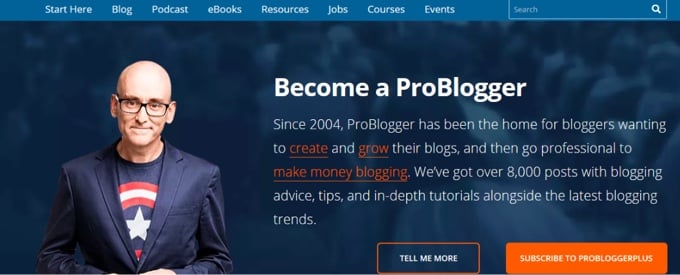
Now, emotional copywriting is a vast subject, and discussing every nitty-gritty of it is beyond the scope of this article. Many extensive guides are already available online.
However, I would like to discuss how to use language to match your readers’ limbic profiles and emotional states.
As discussed above, the same stimulant can evoke completely different emotions based on a user’s limbic profile. What feels amazing to a hedonist might turn off a traditionalist. That’s why it’s essential to sprinkle in words that align with your readers’ limbic profiles.
Allow me to explain it with an example.
Patek Philippe is a luxury watch brand. They usually target incredibly wealthy people with refined taste. If you look at the limbic map, many Patek watch customers are “traditionalists.” They value justice, tradition, quality, and reliability.
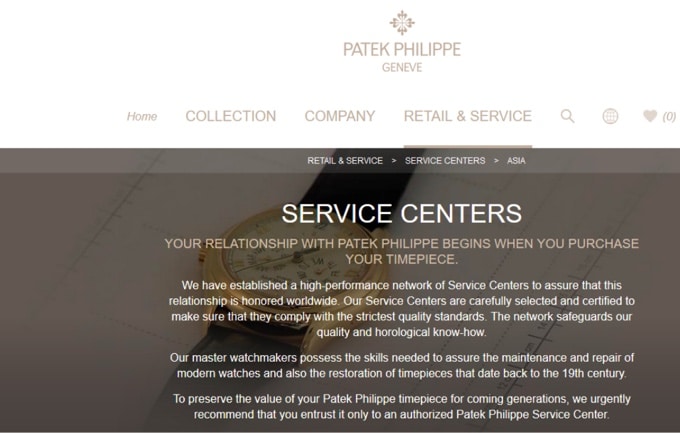
In their web copy, you see words and phrases like “carefully selected,” “honor,” “value… coming generations.” These words are used intentionally to connect their target audience emotionally. It’s a very effective way to subtly appeal to the emotional side of your readers’ brains.
But writing your copy based on limbic profiles also has limitations. Think about this: When your business appeals to a larger, mixed-bag audience, how many versions of the same marketing copy are you going to create?
In such situations, amplifying individual emotional states does a stellar job. But what do I mean by “emotional state”?
Consumers or visitors associate different sets of emotions with different businesses. These emotions influence their purchase behaviors. For example, people are more likely to try spicy, exotic food when they feel a little “adventurous.”
Your job is to amplify whichever positive emotions people associate with your business by using the right words. What you are doing here is getting readers attached to your brand by being the source of positive emotions.
Athlean X web copy is an excellent example of how to do it right.
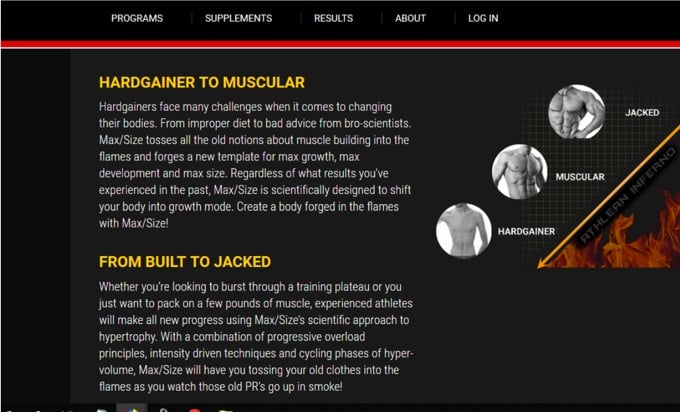
People associate emotions such as strength, achievement, and a sense of growth with fitness. Look at the usage of words here. “Growth mode,” “Intensity-driven,” “old PR’s go up in smoke”—- these are chosen to amplify the emotions people want to feel.
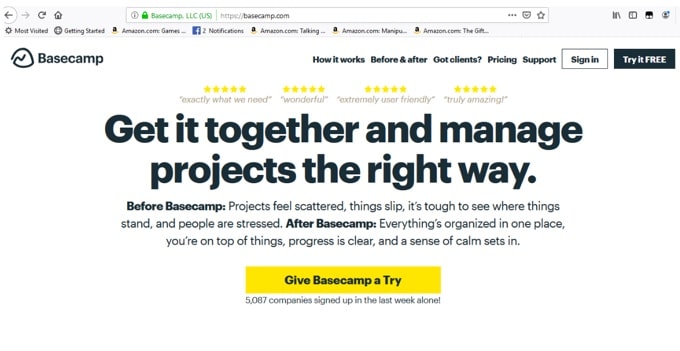
Let’s see another example: Basecamp.
Basecamp is a web-based project management tool.
Their audience is business people who are looking for a reliable way to keep their projects and teams on the same page, which often is not the most straightforward task.
Basecamp offers a solution to its audience’s problem. Basecamp web copy does a great job of reassuring the reader.
First, the headline. It’s in bold font and directly addresses visitors’ pain points. The paragraph below the headline further emphasizes how much difference the tool can make. The entire web copy adheres to this theme and addresses customer objections one by one.
Without a doubt, this is another excellent example of how to amplify the desired emotional reaction through the words.
4. Powerful storytelling
Evolution has wired our brains for bonding with others through stories. Back in the cave days, knowledge was passed down through generations in the form of stories.
Stories remain powerful. People still get captivated by a great storyteller.
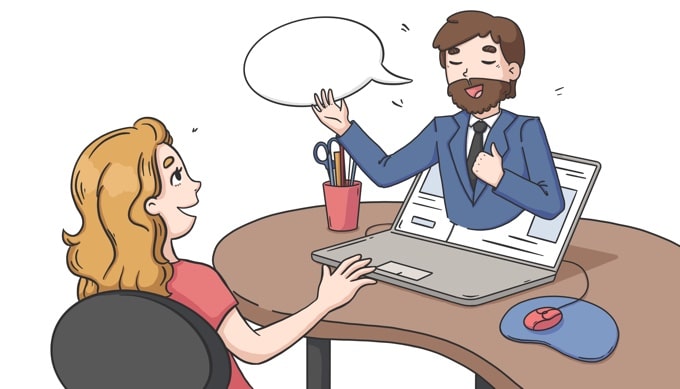
No wonder a great brand story gets the audience out of autopilot and makes them emotionally invested.
But what makes a brand story a good one? Well, a good brand story does a couple of things:
- It shows the audience that the brand is not a faceless entity. It has certain values, moral standards, and a mission.
- It makes the audience a part of the story itself. They start projecting themselves onto the hero, as the struggles and experiences shown are so relatable that it’s hard not to.
Interestingly, when storytelling is done right, the brand never gets the spotlight. It’s always the audience who takes the role of the hero. In a good story, a brand is like a loyal sidekick who helps the hero to win.
Muscleblaze’s “Tum nahi samjhoge” ( You won’t understand) campaign is an excellent example of successful brand storytelling.
Muscleblaze is an India-based sports nutrition brand that targets fitness enthusiasts and athletes.
In a country like India, where academic excellence is held in the highest regard, athletes don’t get the encouragement they deserve. Those who pursue careers in sports or fitness often face a lot of criticism and doubt, even from their friends and family.
Muscleblaze started its campaign with a hard-hitting YouTube video depicting the silent discipline and sacrifices of fitness enthusiasts, which the rest of the world just can’t understand or relate to.
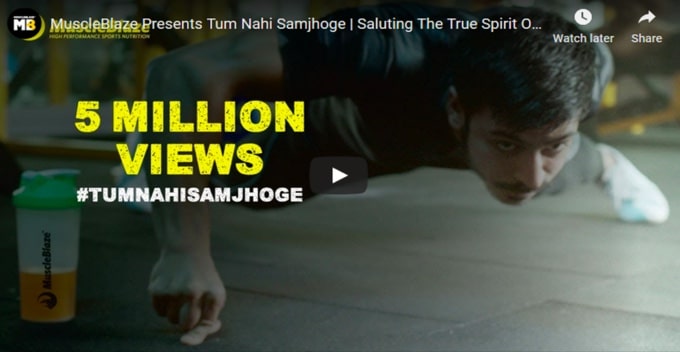
That 2:20 min video so far has managed to get 7.6 M views on YouTube. It’s a great achievement considering this was MuscleBlaze’s first fully fleshed-out campaign.
Along with that film, MuscleBlaze also kickstarted a social media contest #tumnehisamjhoge. The brand asked fitness enthusiasts to share images of their best physique. Fifteen winners were offered free supplements, and the grand prize was a professional photo shoot with a reputed photographer. Muscle Blaze team promoted the campaign on Instagram, Facebook, and Twitter.
Here comes the juicy part.
The campaign received 9000 images and 4000 videos in three weeks. The visitors spent 7X as much time on the Muscleblaze site, and the repeat customer rate reached 23%. Brand searches on Google increased 2.5X.
Last but not least, the total number of views across all the channels crossed the 20M mark.
All of these happened because MuscleBlaze wove a perfect brand story in which the audience was the hero.
MuscleBlaze hired some of the best agencies in the country, but what if your pockets aren’t very deep? Is it possible to still harness the power of storytelling on a limited budget?
Yes.
If you mold your storytelling style to suit your audience and the platform you are using, you are all set.
Josh Braun is an outreach expert and Sales leader. He uses LinkedIn to build his audience. Since short written posts (some call them Broem-s) do exceptionally well on LI, he creates those posts regularly.
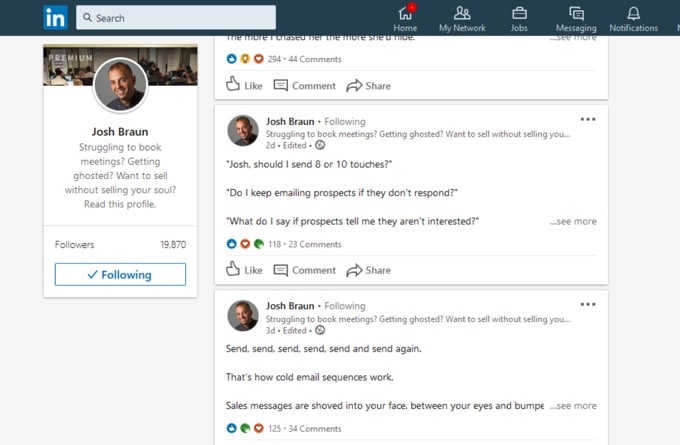
Josh’s posts are relatable and entertaining, and they provide immense educational value. He checks off every box of great storytelling.
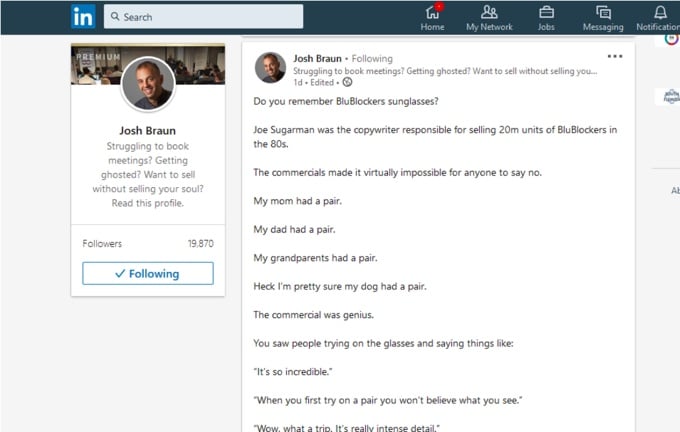
Result? Josh quickly built a sizeable following, which is far more engaging than that of many other influencers of his size.
5. Personalization:
Personalization is an umbrella term for ways of tailoring the customer experience based on each customer’s unique habits, preferences, and background.
Personalization has a profound effect on marketing success. For example, after great personalized experiences, first-time buyers are 44% more likely to become repeat buyers. If done right, personalization can forge emotional bonds between the brand and customers.
There are many ways to tailor the marketing experience, depending on the customers and goals: web, email, product, and whatnot. We have an extensive guide to planning, executing, and measuring personalization efforts.
However, when an emotional connection is the goal, some approaches might work better than others. Usually, personalized experiences with a human touch build strong attachments. That’s why personalized customer service, for example, is more effective than abandoned cart emails in this situation.
Here are two examples of connection-building personalization:
- Sometimes great retail personalization may not require any tech at all. A simple, well-thought-out handwritten note is enough to make the customer feel special.
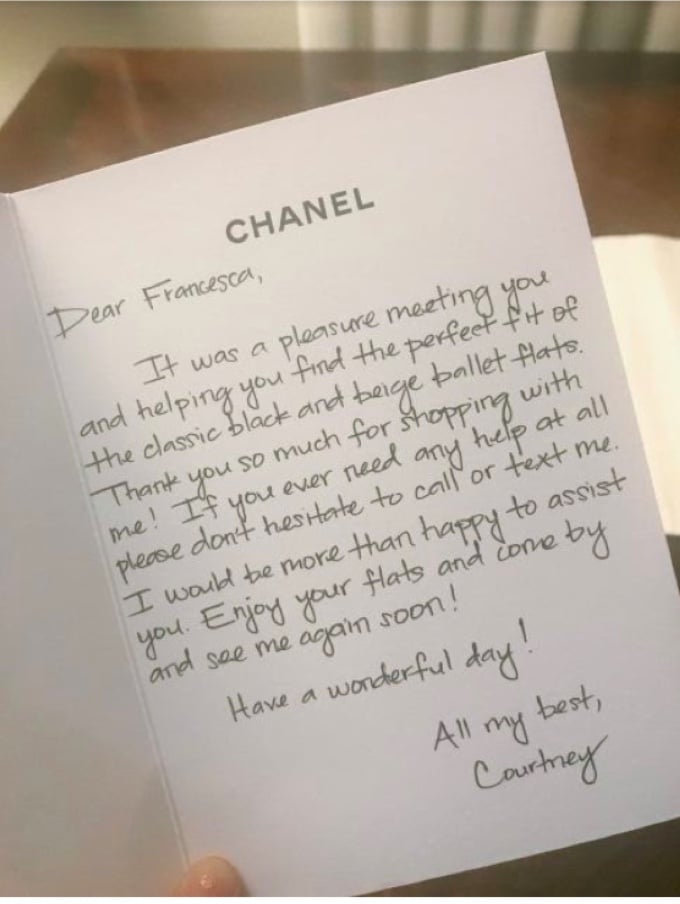
Here is one from Channel. The shopping associate, Courtney, thanked Francesa for shopping with Channel. Courtney closed the letter by saying she is available over text.
This is an excellent example of personalized customer service. As 33% of customers consider customer service quality as a significant determining factor of loyalty, such gestures are priceless.
2. Celebrating “customer relationship milestones” with existing customers is a great non-invasive way of getting into their minds. With the right visual presentation, such an effort immediately sets your brand apart from others.
Take inspiration from the DavidsTea newsletter.
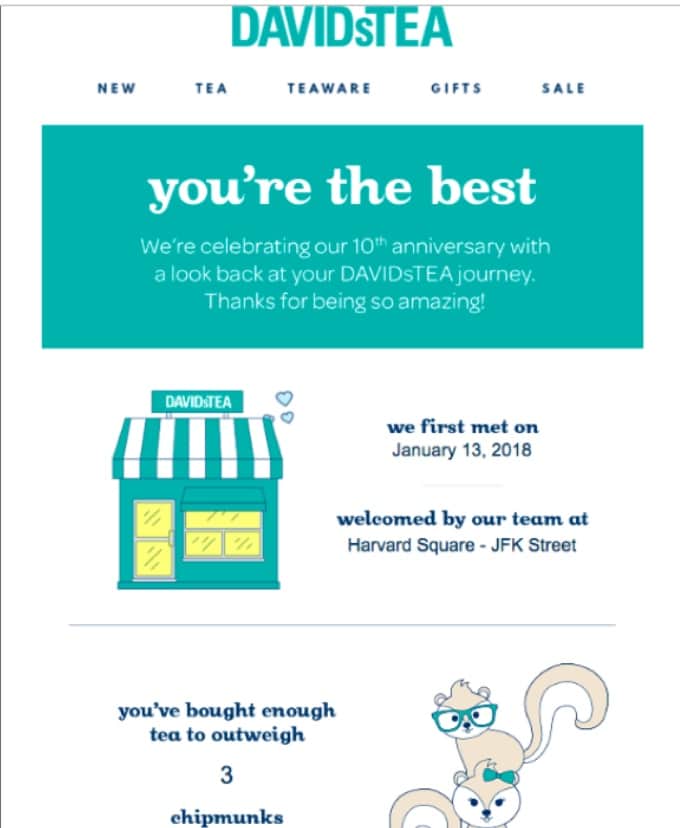
They summarize customers’ entire purchase history and present it in a story form. And they include cute chipmunks too.
Emotional Branding
Have you noticed some brands have a cult-like following? Their fans refuse to buy from any other brands. Their customers wait in line for days to get their hands on the newly launched products. Their loyal users spit fire on internet forums to prove their favorite brand is the best.
That’s what I call a whole new level of branding – customer relationship. Your customers become your supporters.
Powerful emotional branding is the only way to achieve that.
Now, marketers often use “emotional branding” and “emotional advertising” interchangeably. However, there is a difference between these two.
Emotional advertising is a one-time thing. You can create an advertisement and make users feel a certain way. But after some time, when the novelty wears off, everybody slips back to autopilot.
Emotional branding is much bigger than that. You start by understanding who your audience is and what you want them to feel about your brand. After that, every campaign you start, every piece of content you publish, and every post that goes live should be aligned so that they contribute to the brand image in your audience’s mind. You set your brand as a trigger for certain feelings.
But how do you start doing emotional branding in the first place?
By researching your audience and being polarizing. Emotional branding by nature is polarizing. Within limits, the more polarized your brand is, the more powerful an emotional response it inspires. For example, Harley-Davidson has a certain image, and their bikes are the go-to choice for rebels, toughs, and free spirits. Harley has a cult-like following.
Any brand that takes a mass approach can’t create such a strong emotional response.
You want your brand to attract your target audience hard and repel others. When you go niche, it’s easier to be polarizing in the right way.
Once you determine who your audience is and are ready to stand out, you start designing, writing, and crafting stories to get them hooked.
Understanding the target users’ limbic profile comes in handy here. You can pick one or two emotional triggers they value and stick to those.
Rolls-Royce is a perfect example of emotional branding done right.
They target the wealthy, powerful top 1% of society. If you consider the limbic profile of Rolls-Royce’s audience, they are mostly “Performers”– go-getters, sophisticated, elite, assertive, and powerful.
Everything about Rolls-Royce screams power and sophistication.
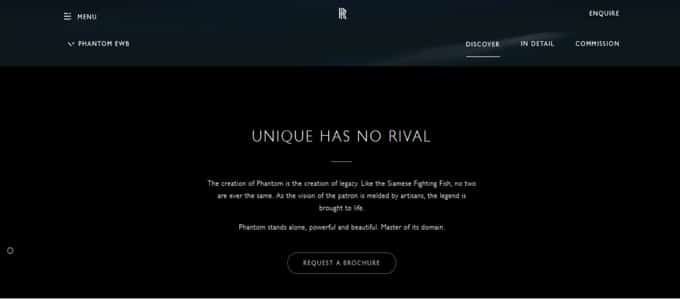
Take a look at the copy. “No Rival,” “Powerful and beautiful,” “Master of its domain”— these words convey a sense of dominance and superiority. It’s something that Rolls-Royce’s audience values.
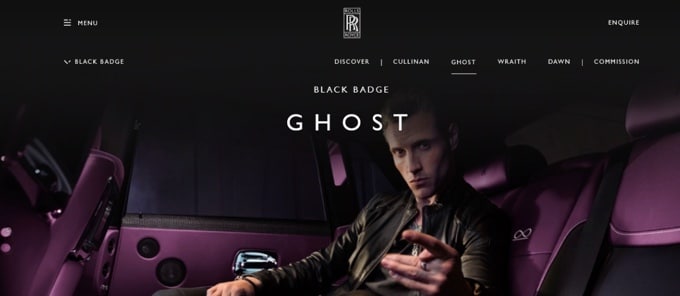
Let’s talk about design and visuals. The primary colors are black and purple— both are associated with power and royalty. Here is an image of a young-ish man who looks sophisticated and assertive. Again, the design is catered to the target audience.
Another example to learn from is Shinola, a Detroit-based luxury product brand. What makes Shinola unique is that they try to be a genuine American luxury brand in every sense. From choosing slogans like “where America is made” to hiring a local workforce, everything Shinola does aligns well with its image. If you go through their site, you would see how this sentiment is reinforced in their copy and design.
Here is a product description from Shinola.
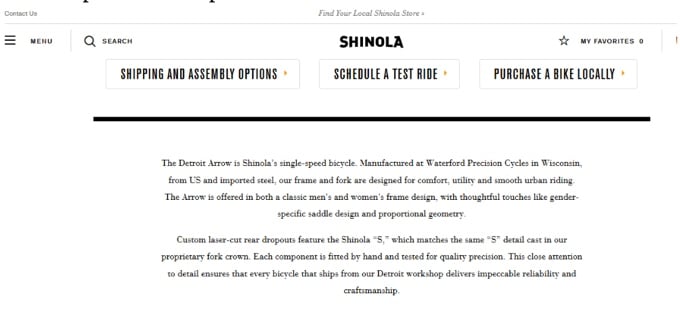
They pointed out that their materials and manufacturing are from America.
Even their blog topics are on American culture and people.
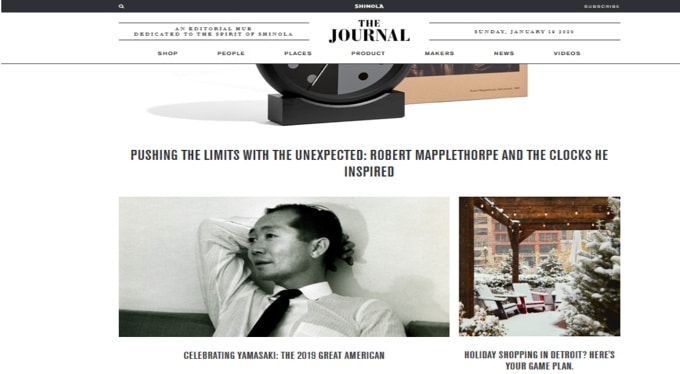
Another interesting thing is how Shinola maintains its image as a luxury brand. They use a vintage-looking design: a lot of white space, black-and-white photos, and a traditional font style. Such a design is common among posh, luxurious brands, as they tend to be classy and subtle.
Interestingly, Shinola is a new company compared to other luxury brands. Still, it managed to pull this vintage American luxury brand image well.
And whom do they attract? Wealthy Americans who take pride in their country, and even U.S. presidents. Former President Bill Clinton bought 14 Shinola watches and called the company an American success story. Former President Obama also gifted a custom-made Shinola watch to UK Prime Minister David Cameron.
Needless to say, when presidents are fans of Shinola, they are doing it right.
Conclusion
Customer loyalty is all about fostering emotional attachment. And to do so, you need to appeal to their emotional sides. Now, everyone might not have the same triggers. You need to identify their “buttons” with the help of tools like the “Limbic model” and address their underlying motivations.