

Wondering if CRO is worth the investment for your website?
Here’s the simplest way to think about it.
If your website already makes millions, even a small improvement can be worth a lot.
If traffic is low, you may not have enough data to test properly.
And if the real problem is poor traffic, weak positioning, or an offer people don’t want, CRO won’t fix that either.
So don’t start with:
“How much can CRO increase our conversion rate?”
Start with:
“If CRO works, will the upside be big enough to justify what we spend on it?”
That’s what this article will help you figure out.
1. Start with the money, not your conversion rate
Suppose two ecommerce companies both convert at 2%.
That doesn’t mean CRO is equally valuable to both of them.
One generates $1 million a year online. The other generates $30 million.
A 5% improvement in revenue is worth:
- $50,000 to the first company
- $1.5 million to the second
Clearly, what seemed like the same percentage improvement has drastically different business cases.
That’s why your current conversion rate alone tells you surprisingly little about whether CRO is worth the investment.
Instead, start with the amount of revenue flowing through the part of the customer journey you can realistically improve.
For ecommerce, look at numbers such as: How much your website makes now × the improvement you think is realistic × how much of each sale you actually keep
You can find your current website revenue in Shopify, GA4, or whatever ecommerce platform you use. For the last number, ask your finance team: after product costs, shipping, discounts, and other direct costs, how much money do we actually keep from each sale?
For SaaS or lead-generation companies, you may need to work further down the funnel:
How many extra good leads CRO could generate × how many of those leads usually become customers × how much an average customer is worth
Your sales team or CRM should already show how many leads become customers and what a typical customer spends.
That brings us to the next question: how much improvement would CRO actually need to deliver to be worth the investment?
How much extra revenue does CRO need to generate?
Say your website makes $10 million a year and you spend $150,000 a year on CRO. A 1.5% revenue increase would generate another $150,000.
But don’t keep every dollar of revenue after product, shipping, payment and other direct costs.
So ask your finance team:
“If we generate an extra $100 in sales, roughly how much of that do we actually keep?”
That tells you how much additional revenue CRO really needs to generate to justify the cost.
And don’t judge that only by conversion rate. For ecommerce, look at essential CRO KPIs like extra revenue and profit the change generated. For lead-gen businesses, look at whether the extra inquiries actually turned into customers.
In one recent Invesp ecommerce experiment, important product and trust content was sitting too far down the homepage. We moved sections such as bestsellers, testimonials and FAQs higher up.
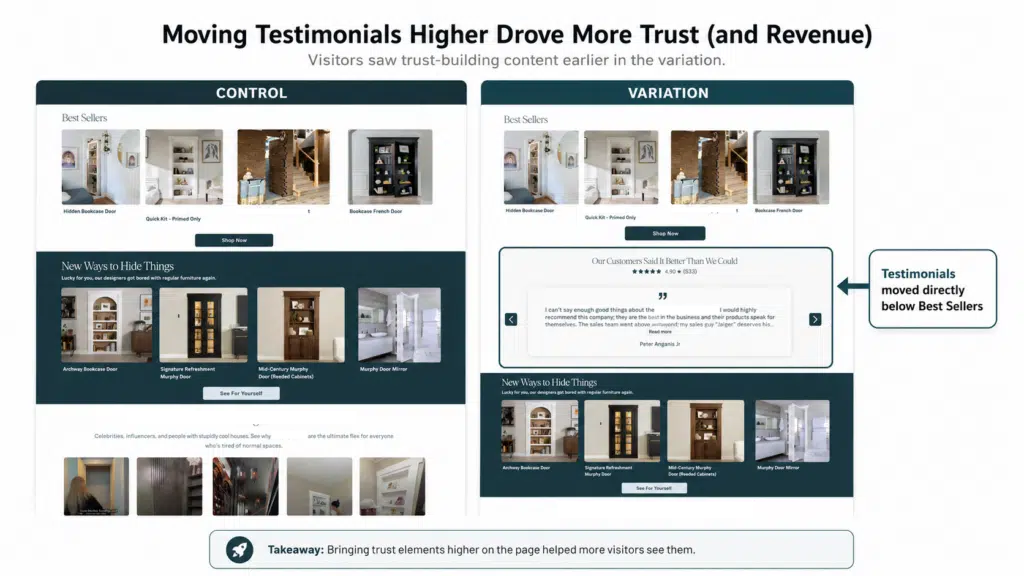
Over 35 days, desktop conversion increased from 1.08% to 1.26% and mobile conversion from 0.49% to 0.54%. The estimated revenue impact during the test was more than $138,000.
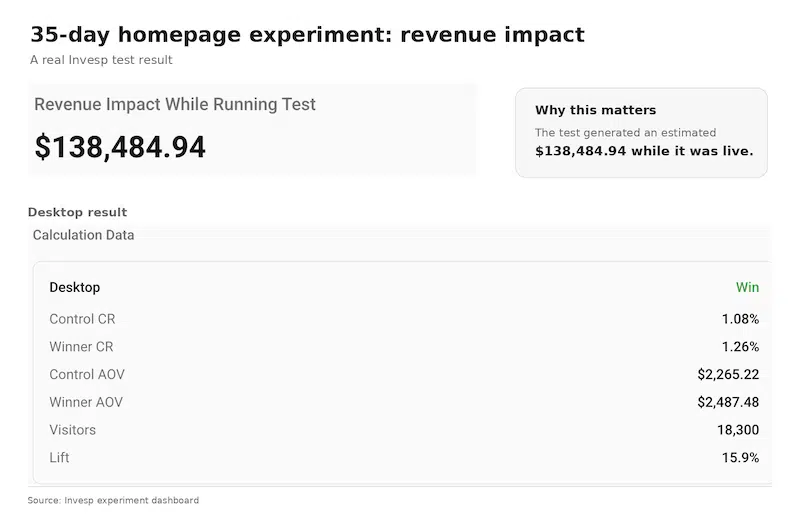
A move from 1.08% to 1.26% doesn’t look enormous on a dashboard. But when a website has enough traffic and customers are placing high-value orders, even a relatively small improvement can translate into a meaningful amount of money.
The same test also shows why we don’t look at conversion rate alone. Mobile conversion went up, but the average amount spent per order went down.
So when we evaluate an experiment, we don’t stop at:
“Did more people buy?”
We also ask:
“Did the change actually make the website more money?”
That’s ultimately the number you need to compare with what you’re spending on CRO.
2. Check whether you have enough traffic and conversions to learn anything
A/B tests split visitors between different versions of a page. If you only get a handful of conversions each month, it can take months to know whether one version actually performed better.
And there isn’t one traffic number that works for every business.
The required sample depends on:
- Your existing conversion rate
- The size of the improvement you want to detect
- How much traffic enters the experiment
- The level of statistical confidence you require
For example, an experiment I came across has a 15% baseline conversion rate and aims to detect a 10% relative lift at 95% significance. It estimates roughly 8,000 visitors per variation would be required.
Change the baseline conversion rate or try to detect a much smaller improvement, and the required sample changes substantially.
This matters because an experiment that needs six months to produce a useful answer can make little commercial sense.
As a practical rule of thumb, Invesp has historically recommended around 500 conversions per month before relying heavily on A/B testing, because running tests with too little conversion volume can leave you waiting months for a useful result.
But low traffic does not mean there is nothing to optimize.
It may simply mean that a continuous A/B testing program isn’t the right first investment.
Customer interviews, usability studies, analytics analysis, session recordings, surveys, and expert reviews can still uncover obvious barriers. Those findings can inform higher-confidence changes without pretending every adjustment can be validated through an A/B test.
3. Work out whether the website is actually the bottleneck
CRO can improve what happens after the right visitor arrives.
It cannot manufacture demand that doesn’t exist.
Before investing heavily in CRO, ask:
Are enough of the right people reaching the website in the first place?
If you’ve just launched, have almost no traffic, haven’t found product-market fit or are sending badly targeted paid traffic to the site, acquisition or positioning may deserve attention before an ongoing experimentation program.
But if you’ve already built meaningful traffic and large numbers of visitors disappear between important stages of the journey, the economics become more interesting.
For ecommerce, examine the movement from:
Product page → Add to cart → Cart → Checkout → Purchase
For SaaS:
Landing page → Signup/demo request → Activation/qualified lead → Paid customer
Look for where money is leaking rather than simply looking at your site’s overall conversion rate.
Checkout is an obvious example. Baymard’s 2026 dataset puts the average documented ecommerce cart abandonment rate at 70.22%, based on 50 studies.
That does not mean 70% of your carts are recoverable. Some shoppers were never going to purchase.
But Baymard’s usability research estimates that large ecommerce sites can potentially gain substantial conversion improvements specifically by solving documented checkout usability problems.
The useful question isn’t:
“Is our abandonment rate higher than the industry average?”
It is:
“Why are our customers abandoning, and are those reasons something we can actually change?”
That’s what conversion research should answer.
4. Ask whether you’re guessing too much
We recently reviewed the problems companies brought up during Invesp’s sales conversations.
The largest group at 27% talked about needing more conversions or revenue.
But the next biggest problem wasn’t “our CTA button needs work.”
23% talked about tracking, measurement, or difficulty understanding the customer journey.
Another 18% struggled with knowing what to prioritize, while 17% raised problems around trust, messaging, or helping customers understand the product.
Checkout, cart or payment friction appeared in 16% of conversations, and 14% raised issues around execution speed and implementation.
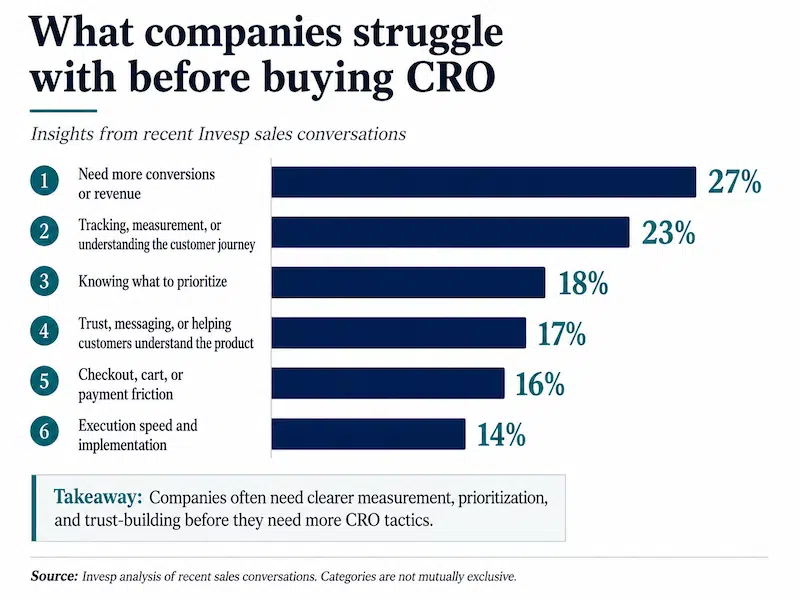
Source: Invesp analysis of recent sales conversations. Categories are not mutually exclusive.
That distinction matters.
For many companies, the value of CRO isn’t merely finding a page that can produce another 5% conversion lift.
It’s replacing:
“We think this is the problem.”
with:
“Here’s where customers struggle, here’s the evidence, and here’s what we should test or fix first.”
If your team already has twenty website ideas but no reliable way to decide which five deserve development time, that prioritization itself has economic value.
5. Make sure you can actually implement what you learn
You can have plenty of traffic, clear conversion problems, and a large financial upside and still waste money on CRO if no one is there to make the changes.
Ask what happens after research identifies an opportunity or an experiment produces a winner.
Can your developers implement it?
Can tests get through design, legal, and brand review?
Can analytics problems be fixed?
Will somebody make a decision when the evidence contradicts the team’s original opinion?
If every change gets trapped in an approval queue for three months, buying more research won’t solve the bottleneck.
We’ve seen the same issue with testing itself. An organization has to be willing to accept that customers may prefer a design the internal team dislikes. Invesp has documented cases where companies rejected statistically convincing winning variations because executives preferred the original design.
CRO only creates value when the business can act on what it learns.
6. Don’t assume every CRO idea will make money
This is probably the biggest misconception about the investment.
You’re not paying a CRO team because it knows, with certainty, which variation will win.
You’re paying for a process that improves the odds of finding valuable opportunities and stops bad ideas from being rolled out blindly.
Consider a test we recently ran around a wishlist feature.
The logic behind it seemed reasonable: visitors were returning and browsing products repeatedly, so letting them save products might make it easier to rediscover and compare items.
The experiment did not produce the expected result.
Overall, it was inconclusive. Checkout page views declined in both variations, and the estimated revenue impact during the test was approximately -$83,000.
Without testing, a company could easily have built the feature, rolled it out to everyone, and called the project a UX improvement.
A negative experiment isn’t necessarily wasted money.
Sometimes not shipping the idea is the return.
So, is CRO worth it for your website?
A full CRO program is usually a stronger investment when:
| Question | Strong signal |
|---|---|
| Does meaningful revenue already flow through the website? | Yes |
| Would even a modest lift be financially meaningful? | Yes |
| Do you have enough traffic and conversions to run useful experiments? | Yes |
| Are visitors dropping between important funnel stages? | Yes |
| Do you have questions about why customers aren’t converting? | Yes |
| Are teams debating changes based largely on opinion? | Yes |
| Can your company actually implement what research and testing uncover? | Yes |
| Can you measure revenue, qualified leads or another real business outcome reliably? | Yes |
If you don’t have enough traffic or conversions to run useful tests, start by finding out what’s stopping people from converting instead.
If tracking is unreliable, fix measurement first.
If almost nobody is reaching the website, focus on acquisition.
And if the economics say you would need a large improvement simply to recover the cost of the program, CRO may simply not be the right investment yet.
If you’re trying to work out whether CRO would generate enough value to justify the investment, talk to our team. We’ll look at your traffic, conversion volume, and business economics and tell you whether a CRO program makes sense for you right now.