


Whenever a new medium comes along, whether to communicate or to sell, our initial reaction is to apply the conventions of the old media to the new one and see what happens.
Many of the first television broadcasts were simply radio programs performed before a camera. And our first attempts at ecommerce were dominated by online malls that imitated their brick-and-mortar predecessors. While a few still exist, they are by no means the model of current ecommerce.
After 20 years, we still haven’t learned enough about ecommerce to get average conversion rates into the high single digits. The reasons are at least partly related to our insistence on applying old thought patterns to a new way of selling.
Retailing used to be a relatively simple concept. You open a store, you advertise, shoppers visit, and some buy. Awareness, interest, desire, action. While the purists will be quick to point out that we have left out a few details in that brief scenario, the point is that before online browsing and shopping, bricks-and-mortar retail was a relatively straightforward pursuit.
And that’s the mind-shift that we are only just beginning to grasp. Versus regular retail, there are exponentially more tipping points, some on tangents to others, between online shoppers and their conversion. Each point is a minefield of issues that no retailer had to deal with until relatively recently, from the security of personal data to shoppers’ ability to flit from one store to another in mere seconds.
And Then Mobile Devices Came Along
As if the old straight line of retail hadn’t been warped and splintered enough by ecommerce, mobile devices shifted our thought parameters yet again – even before we’ve really defined the ecommerce playing field.
What Does All This Have To Do With Improving Your Mobile Conversions?
First, the term “mobile devices” usually refers to tablets and smartphones. But the facts show significant differences between the two for ecommerce. How many times have you seen anyone comparing products/prices using their iPad in a store? And there are big differences in their ecommerce conversion numbers.
- While annual ecommerce sales made with a tablet almost quadrupled between 2012 and 2015, they just more than doubled on smartphones in the same time period.
- Conversion rates on tablets are about 25% lower than on desktops, but 200% higher than on smartphones.
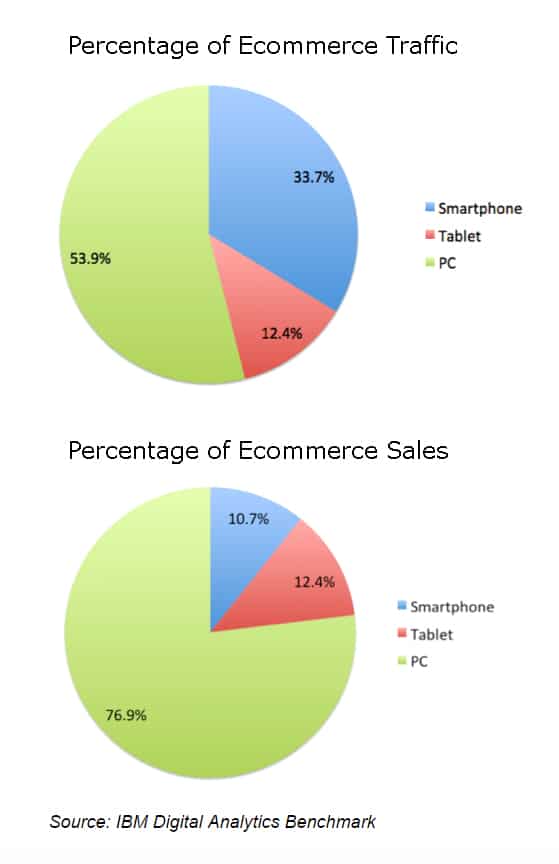
- Check the graph below from marketingland.com: shoppers do a lot of research with their smartphones, but relatively little buying when compared to tablets and PCs.
So while we talk about mobile devices here, if we refer to using your mobile device “in-store,e” you can bet it’s a smartphone.
Before you optimize your conversion rates on mobile devices, you need to optimize your thinking about how to approach it, and the differences between shopping on smartphones and tablets force you to split your thinking even further.
If we finally have the idea that we must reset our perception of retail conversions to maximize them online, then even newer perspectives are in order before we can optimize conversions for mobile commerce.
Mobile Commerce is a Cross-Platform Affair
Think of “showrooming”, the practice of shoppers visiting a brick-and-mortar showroom to see a product and then using their smartphones to find a better offer for the same product at another store or online. Unlike brick-and-mortar and desktop ecommerce, we use our smartphones as part of a cross-platform buying process (as the pie chart above confirms).
So optimizing for smartphone conversions means thinking of it as part of a multi-device approach to selling online.
1. Adjust your Analytics to Get a Better Idea of the Role Mobile Plays in Converting Your Online Customer
In a way, mobile devices are cheated when we determine the conversion rates from them. If we use them for research and then buy on another device or in-store, who’s to say the conversion in the consumer’s mind didn’t take place on the mobile device? The problem is that most analytics are not yet at the point where we can effectively track a prospect on a conversion path across platforms. But you can use tracking devices, like a Google forwarding phone number or similar phone-number tracking, a coupon or discount code, to help us get an idea of whence the consumer came.
2. Offer an Option to Continue Shopping on Another Device
If shoppers use mobile devices for research, but buy on other platforms, then why not make it easier for them to do so? Allow them to save their shopping cart, create a “wishlist,” or email their cart.

3. Be careful with App Pop-Ups
Considering your investment in a mobile app, it’s very tempting to put it to work and offer it whenever possible. But consider the frustration that doing so could generate for smartphone shoppers if they get your app pop-up instead of the quick information they seek to purchase on your desktop or tablet site.

4. Use Device Detection to Optimize Your Site for Each Device
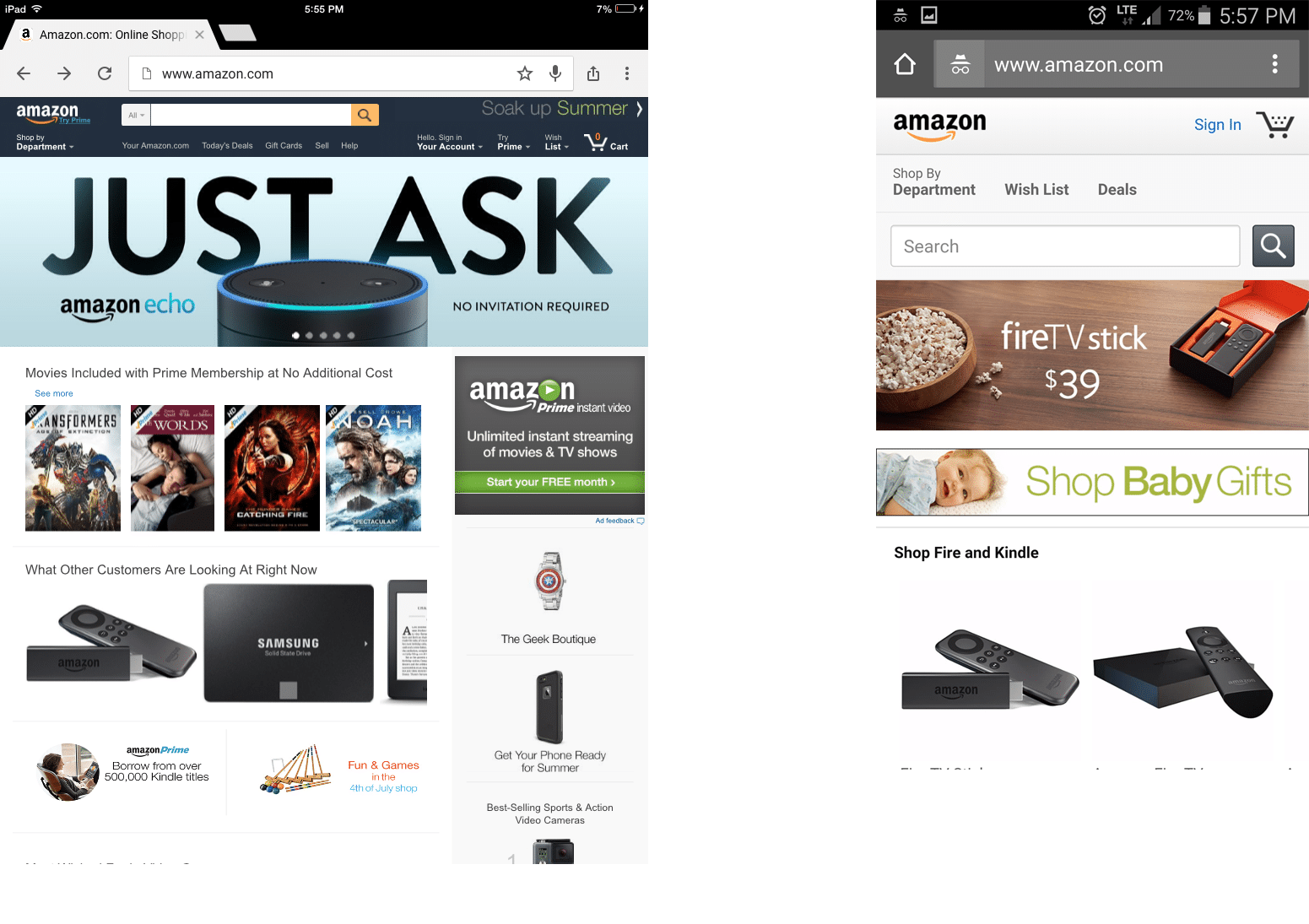
If there are significant differences in how shoppers use smartphones and tablets, don’t serve the same site on both devices. Consider that shoppers will access your site on their smartphone in a wide variety of surroundings and lighting conditions. Not only is the screen smaller, but it can be difficult to see. Check out the differences below on Amazon.com, accessed via an Android smartphone, an iPad, and a desktop PC.

5. Consider that Smartphones are the Only Device In-Hand at a Bricks & Mortar Point of Sale
This might be the most important shift in thinking you could make. Whether they are in your store or someone else’s, devise ways, including instant savings, to capitalize on their whereabouts when they land on your mobile site.
6. Offer a Consistent Mobile Experience
Mobile conversions include lead generation too. Webex niftily offers a crisp, bright, mobile-optimized email to encourage new account sign-ups. Brilliant idea. But imagine the letdown when, after taking the call-to-action, Webex sends you to what appears to be a desktop landing page that needs zooming and swiping to read and use.
When we see a mobile-optimized page or email, we get all ready for a mobile-optimized experience. If it doesn’t happen, the disappointment and urge to leave the conversion path are greater than if we had not been given a mobile-optimized page in the first place.
Change Your Thinking
That’s the overriding point. Check the data, do your research, and don’t apply the conventions of other forms of converting, even other forms of online conversions, to your mobile conversion optimization. Then test accordingly.
Sources:
http://www.entrepreneur.com/article/240797
http://www.emarketer.com/Article/Retail-Sales-Worldwide-Will-Top-22-Trillion-This-Year/1011765