


Before jumping into conversion optimization, you need to identify your site visitors by recognizing, for example, concerns, motivations, uncertainties, and trigger words.
One of the first tasks we do as a company that has been helping marketers optimize their content and conversion rates is to delve into understanding the market as best we can prior to initiating the recommendation process.
Most companies are aware of the importance of understanding their customers, but few grasp all that this entails, especially online. The majority are still keeping their heads in the sand and overlooking the high costs of stepping away from clients.
The Global Customer Service Barometer, after interviewing more than 1,000 adult customers about how they view their brands, reports disappointing results: 38% of participants believe that businesses are not customer-oriented and fail to provide enough attention.
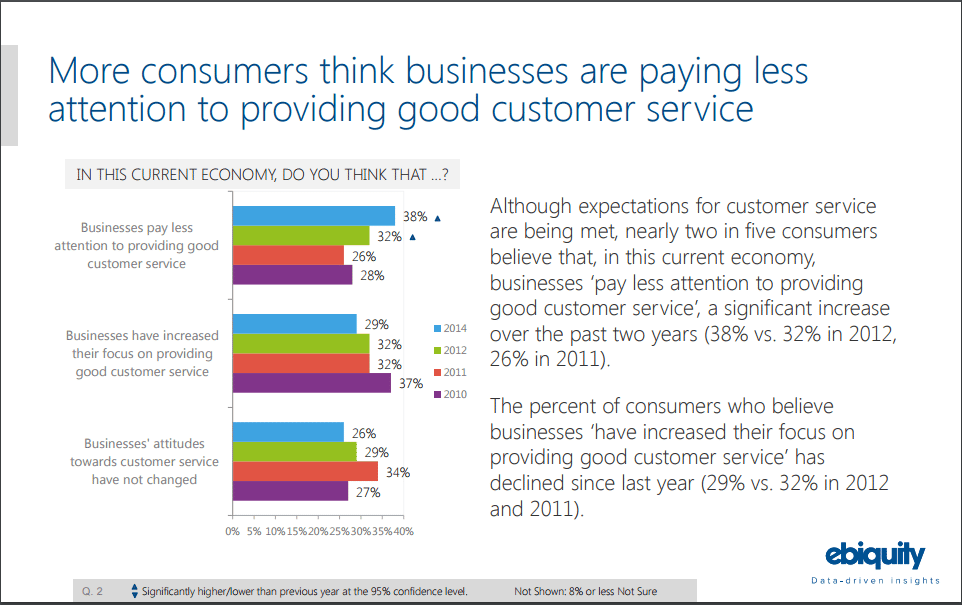
Image source: AmericanExpress
The data show that many people are frustrated by how businesses still use outdated methods to interact with their customers and pay too little attention to their needs.
We find that companies face one of two challenges when it comes to integrating their marketing data into their selling process:
- Smaller companies lack the know-how or means to conduct research to effectively identify and segment their markets. Some of them might not even appreciate the value market research brings to their business. As a consequence, they often make assumptions about their clients that are wrong and risk missing crucial segments that can generate significant revenue.
- On the other end of the spectrum, many mid- to large businesses conduct due diligence by researching the market but do not know how to apply the results. They are unable to integrate that data into actionable insights that can be applied to their sales process, marketing campaigns, or their websites.
Regardless of the size of the company, the overwhelming question is: how do you use the marketing data to make sure website copy, design, navigation, and overall site structure will engage most visitors, if not all, and move a high percentage of them through the conversion funnel?
When the average e-commerce store converts only 3-5% of its visitors into customers, you must pause and wonder what is stopping the other 95% from proceeding with the purchase.
Conversion optimization starts with gathering detailed market information. The more detailed the information, the more precise the optimization process. You then use that data to shape your website’s interactions with visitors.
The most efficient way to address market concerns is to create buyer personas.
But what are personas? And how can they help with conversion optimization?
Buyer personas are models, examples, and archetypes that humanize and individualize a precise target market. They are hypothetical individuals who represent target consumers.
Image source: Amy Cotton
Through persona creation, you should be able to relate to customers on an individual level, bringing personalization, engagement, and enthusiasm to your website by understanding what appeals to them and what turns them off.
And because buyer personas are at the helm of conversion optimization, they should guide every aspect of your website, including user interface and screen design, process flow, and web copy development.
Too many websites cater to the masses and not to a single person. As a result, the copy is dull, the design is boring, and visitors are left frustrated.
Creating your own buyer personas will help you relate to your customers’ different personalities and address their needs accordingly.
Market Segmentation Vs. Persona Creation
When we first present the concept of buyer personas to our clients, they often mistake persona development for market segmentation. These are not the same. However, persona creation relies heavily on market segmentation.
To create buyer personas, you need to understand market segmentation and the various customer profiles you compiled with your team. Segmentation is the division of the market or population into subgroups with similar motivations.
Also keep in mind that there is a huge difference between marketing to a business (B2B) and marketing to a customer (B2C), although both involve selling to a person.
The widely used bases for segmenting business-to-customer markets usually include geography, demography, personality (behavior), and psychographic factors. The bases used to segment business-to-business (B2B) markets differ; they include location, company type, and behavioral characteristics.
This article focuses on the techniques used in B2B markets during the buyer persona creation process.
The use of personas is growing rapidly, as more than 93% of companies that exceed revenue and lead goals use personas, segmenting their databases accordingly to personalize experiences for their visitors.
A recent study on the most important elements of effective B2B content has demonstrated that audience relevance ranks the highest at 90%.
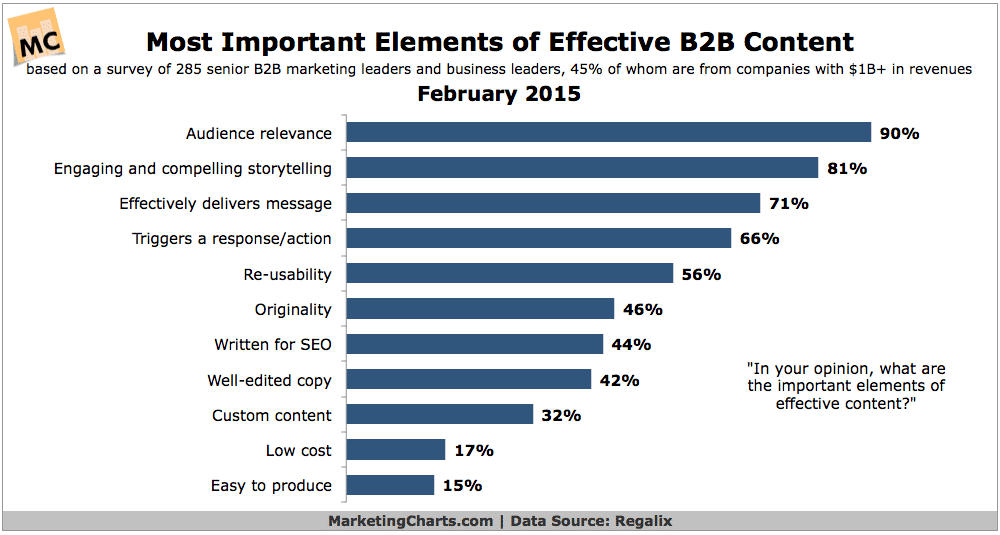
Image source: Marketing Chart
In another survey of 640 global senior B2B marketing executives and business leaders, half of whom are in the internet and software industries, 69% of participants agree that understanding buyers’ needs or pain points is the most effective go-to-market strategy for a product launch.
These studies show it’s high time for marketers and business owners to put their feet in their customers’ shoes and start building buyer personas that reflect their customers’ real needs and demands.
Every company, online or offline, must understand the market they operate in and the best techniques to better serve their ideal customers.
You can go in depth and analyze the various demographics and similarities within the market to create segments and narrow the target market. This information must be quite detailed to create the ideal target customer.
How Are B2B Marketers Building Buyer Personas?
Cintell surveyed 137 B2B marketers to find out how they build their buyer personas and what data they use.
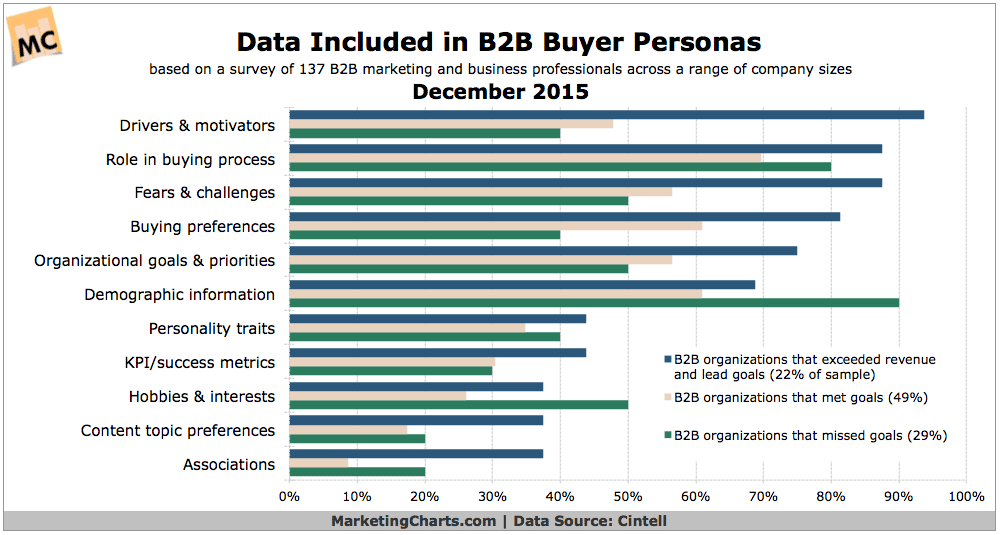
Image source: Marketing Charts
The survey segmented these marketers into three different groups, as shown in the graph above. The first group, the one doing well by exceeding revenue and lead goals, was conducting qualitative interviews for both customers and non-customers, including the executive team and the salespeople. The data obtained were more likely to be segmented by demographic factors than by other fields mentioned above, and their focus was on addressing the fears and motivations of their customers, as these are more applicable to buyers as individuals.
Consider a site that sells discount furniture, catering to three different market segments:
- Middle-income families, middle-aged, 70 – 100k household income
- College students, 10- 25k income
- Building company
The three markets differ in income, personality traits, and needs. Their interests and motivations for the purchase differ. One group is purchasing for their families, another for themselves, and a third for potential clients or home staging. The site’s goal is to appeal to all markets equally. Buyer personas help you achieve this goal by guaranteeing you capture each group’s interest.
In this scenario, we would introduce Jennifer, a 45-year-old homemaker. She likes to update her home furniture every year. She enjoys decorating her home and always needs to update because of her rowdy kids. She is price-conscious but looking for something sturdy with good quality. She wants to ensure that her satisfaction is guaranteed because she needs quality items. Return policies are apparently imperative to her.
Compare these traits to those of Evan, a 37-year-old builder who must find great, unique pieces to stage the homes his company builds. He wants to find pieces that are neutral enough for prospects to imagine themselves in the home. He also tries to find items that will pique prospects’ interest so he can sell them with the home. He is not as concerned about price but does have a budget.
Finally, the website targets Sally, a 19-year-old college student who is rooming with two other friends. She needs cheap, nice furniture that’s a bit trendier. She is trying to make a quick decision because move-in is within the next couple of weeks. She needs white-glove delivery and someone to build the pieces. She is looking for practical solutions for their tiny space and considering items with tons of storage.
Selling to these individuals is a lot easier than selling to a general market segment because you can put yourself in Sally, Evan, and Jennifer’s shoes. You can anticipate their concerns and personalize the experience with them.
Buyer personas pave the way for:
- Understanding what makes different segments tick, what appeals to them, and what turns them off.
- Relating to the various personality types that will come and addressing their needs accordingly.
- Recognizing that all users come at different buying stages. Evoking empathy within site developers, marketers, and sales teams.
- Knowing competition well, starting from which market segments are likely to identify with a competitor more than with you, and why?
The Four Temperaments
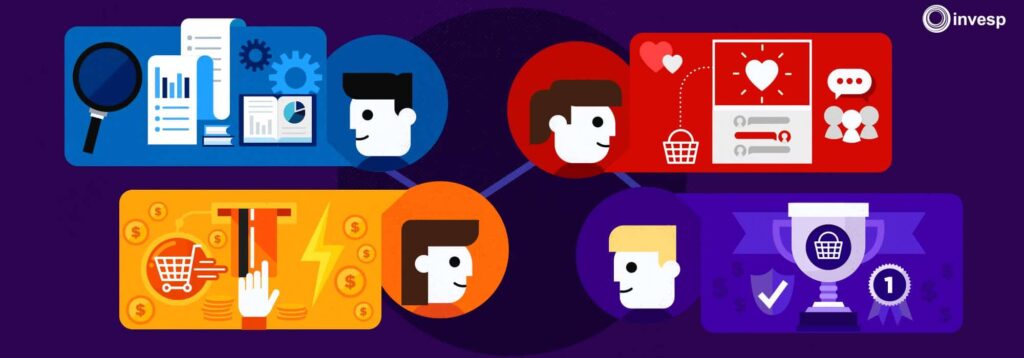
Many philosophers and psychologists have explored the concept of temperaments at length, beginning with Aristotle in 325 BC, passing through Carl Jung in the 1920s, and culminating in a modern-day version by David Keirsey in the 1950s. The concept boils down to the fact that humans carry particular sets of characteristics. For a marketer, understanding what makes each temperament tick can help move the needle on conversions.
As you create each persona, you can also assign a temperament (or a combination of them). That way, when designing, you may have Jennifer in mind, but now you also have in mind that she is a caring person, triggered and motivated by social proof, which can be something to address on the website.
These are the four temperaments to consider.
Logical
A logical persona is meticulous, methodical, and detail-oriented.
When a visitor of a logical nature enters your site, she searches for every single detail of your products and services. She also expects your site to offer answers in a logical, systematic, and easy-to-locate fashion.
Someone logical is going to research your product or service longer, reading and looking for information about it more than others. The purchasing decision for logical personas results from researching, shopping around, and getting to know your and your competitors’ offers better.
How do you address logical personas?
When targeting a logical persona, your site should:
- Have easy-to-locate information.
- Contain answers to all questions about your company (date of establishment, range of products and services offered, reputation).
- Refer visitors to the methodology, the About Us page, or the blog.
- Detailed product pages with detailed descriptions.
- Systematic explanation of your services.
Caring
People impact the caring persona.
A caring visitor to your site looks for reviews and testimonials. She searches for others’ opinions, as well as the number of customers who have used your product or hired your service. People with this temperament are trusting. Their buying decision is influenced by what others say and feel about your company.
The purchasing decision for caring personas takes some time. They are not disciplined in considering alternatives, which makes selling to them a bit harder.
How do we address caring personas?
When targeting a caring persona, your site should:
- Provide testimonials.
- Present news quotes and announce awards received.
- Show numbers of clients.
- Display reviews on product pages.
- Showcase social media mentions.
Impulsive
The impulsive persona buys quickly and regrets it quickly.
The credit-card-in-hand type of visitor may make an impulse purchase but often regrets the decision. Attempt to understand how to get them to click right away, with the right elements visible. However, try to avoid the regret phase by providing them with the information they will need throughout the conversion process.
Impulsive personas are determined to make a purchase. They need to find a reason to buy from you as soon as they visit your site, or they will leave to purchase elsewhere.
Impulsive buyers are an e-commerce company’s dream client.
How do you address impulsive personas?
When targeting an impulse persona, your site should:
- Present benefits in the form of 3 or 4 extremely convincing bullets.
- Include a big “call to action” in a bright color, immediately following the benefits.
- Make sure the check-out process is smooth and fast.
Aggressive
The aggressive persona is highly competitive.
This persona type likes to stand out and acquire the finest products and services. Convincing them that you offer premium, first-rated products or services will help you win them over. These personality types strive to be the best by flushing out the competition.
If an aggressive persona visitor sees a reason your product or service will put them ahead of the crowd, they will be loyal customers.
How do you address aggressive buyer personas?
When targeting an aggressive persona, your site should:
- Offer great incentives, such as the best price and the newest product.
- Give a good reason why your product or service is the best and what it will do for them.
Do you need to address all 4 persona temperaments on your web pages?
That is a good question!
These are some of the things you should keep in mind when creating a web page that caters to the four persona temperaments:
1. Depending on what you are selling, you can determine which temperaments you will probably address. If it is something rather expensive, whatever personality type you are dealing with, the likelihood of more methodical instincts is higher. That does not dismiss the fact that many spontaneous individuals still want to buy cars and diamond rings. However, you can expect them to ask “more” questions because it is a greater buying decision and investment. High-value transactions (contracts worth thousands of dollars) will be meticulously reviewed in a very methodical format. For smaller decisions, you are more likely to have all 4 temperaments.
2. The ratio of temperaments within a population is:
- 45% logical
- 35%impulsive
- 15% caring
- 5% aggressive
3. Within a single page, yes, you absolutely need to have the language that can address these 4 temperaments.
In the video below, part of one of our webinars, Ayat Shukairy and Khalid Saleh discuss different persona temperaments and explain psychological understandings of personas through a historical progression.